Artificial intelligence has changed SEO faster than any algorithm update in recent years.
A few years ago, AI was only used to generate blog posts. Today, it does more, including clustering keywords, building content briefs, optimizing pages, and analyzing competitors.
Search engines have also changed.
Google introduced AI Overviews and AI Mode. Microsoft integrated Copilot into Bing. Search results are now conversational, and users can continue chatting with AI while in the SERP.
These changes make answering this question important:
How should businesses actually use AI for SEO?
Can AI replace SEOs entirely? Or should we avoid it?
The businesses that benefit most from AI won’t necessarily be those using it the most.
They’ll be the ones using it intelligently.
In this guide, you’ll learn:
- The latest AI SEO statistics and what they reveal about the future of search.
- How artificial intelligence is changing SEO.
- Which SEO tasks benefit most from AI?
- Where human expertise remains essential.
- The best AI SEO tools available today.
- How to build an effective AI-assisted SEO workflow.
- Common mistakes to avoid when integrating AI into your SEO strategy.
AI SEO Statistics at a Glance
Nine numbers that define AI’s role in SEO right now.
Adoption
- 63% of marketers use generative AI in at least one workflow. (Salesforce)
- 6% have fully embedded AI into their workflows, despite 80% reporting pressure to adopt it. (Supermetrics)
- 50% of marketers use AI in content creation (Salesforce)
Search behaviour
- AI Overviews reduce organic clicks by 39.8% on the queries where they appear — while users report no drop in satisfaction when the summaries are removed. (Agarwal & Sen, 2026)
- Users click a traditional result 8% of the time when an AI Overview is present, versus 15% when it isn’t. Only 1% click a link inside the Overview itself. (Pew Research Center)
Content
- Roughly half of the new articles published on the web are now primarily AI-generated. (Graphite)
- Pages were 70% more likely to be cited when they mirrored the information architecture of the AI Overview (Konvart)
AI visibility
- Brands recommended by ChatGPT were 2.5x more likely to receive a site visit within seven days than uncited competitors in the same category. (Similarweb)
- 43% of marketers optimize for AI search. 14% measure it. (GoodFirms)
These stats show that AI isn’t replacing SEO, but adding to it. It is changing what “visibility” means, how the work gets done, and whether the traffic that used to prove SEO worked still arrives at all.
Teams are being pushed into AI from the top while lacking the data access and ownership needed for AI to do anything useful. Most AI adoption stalls at the point where a tool needs clean, connected inputs to produce something better than a guess.
For SEO teams specifically, the practical takeaway is that the highest-value applications are those with structured inputs already in place: crawl data, Search Console exports, SERP data, competitor content. Those are the tasks where AI compounds. Content generation, the use case everyone started with, is the one with the most competition and the least advantage left.
We put this to the test on our own site. In a 12-month study, our team found that pages mirroring the information architecture of the AI Overview — while adding original depth on top — were cited 70% more often. Read the full AI Overviews study.
How Marketers Are Using AI for SEO
Although AI-generated content receives most of the attention, content writing represents only one part of how AI is transforming SEO.
SEO and AI teams use AI across several tasks, from discovering opportunities to monitoring performance after publication.
Some of the most common use cases include:
- Keyword research and clustering.
- Search intent analysis.
- Competitor research.
- Content briefs.
- On-page optimization.
- Technical SEO audits.
- Internal linking recommendations.
- Metadata generation.
- Performance reporting.
- AI search visibility monitoring.
As you already know, search is now conversational. Whether searching through LLMs or Google search, people are likely to ask longer questions.
More than that is continuing the conversation within the search bar.
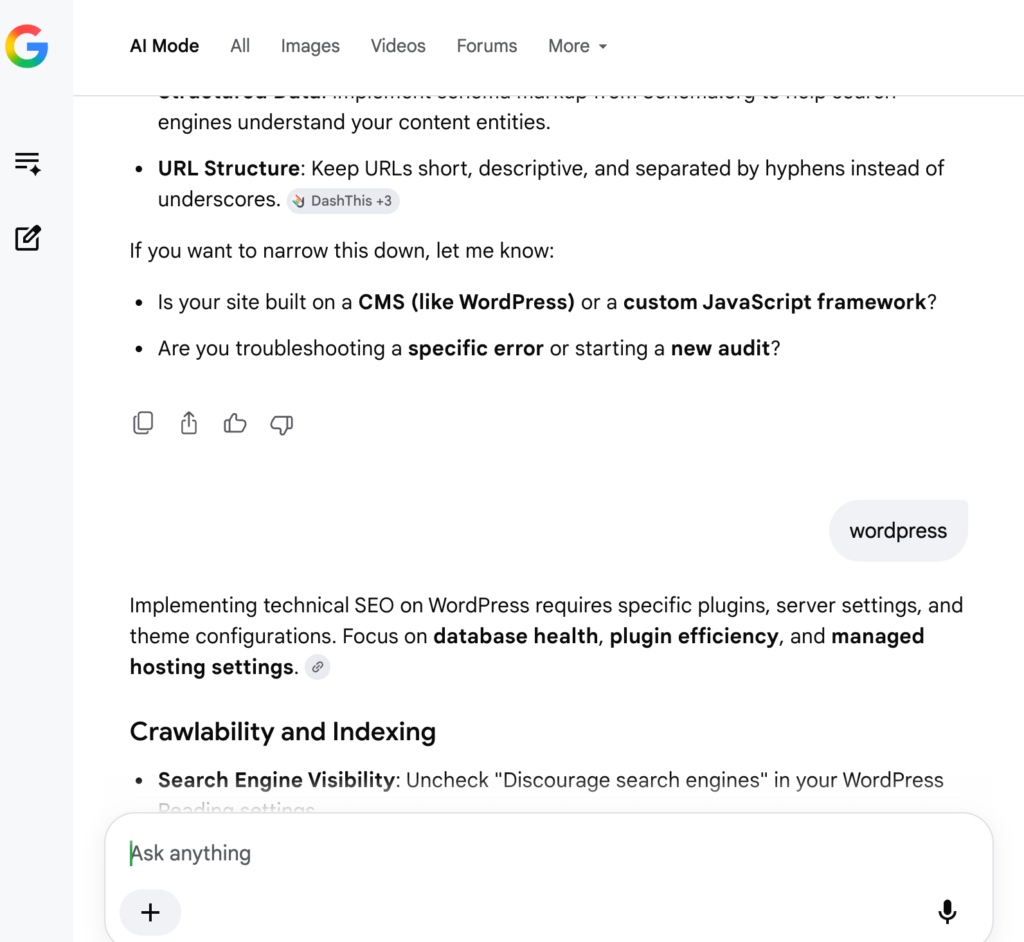
Which means even fewer people are clicking through to sites. As such, rankings are not enough to track the impact of SEO.
A business may appear prominently within an AI-generated answer even if it doesn’t hold the number one organic position.
Likewise, a page ranking first may receive fewer clicks if users find the information they need directly within the search results.
SEO is now about ensuring your brand appears wherever users make decisions.
Where AI Adds the Most Value in SEO
Artificial intelligence isn’t equally useful across every area of SEO.
Some tasks involve analyzing enormous datasets, identifying patterns, or performing repetitive work. These are areas where AI consistently delivers significant productivity gains.
Other tasks require business knowledge, creativity, strategic thinking, or first-hand experience. These continue to benefit from human expertise.
The most successful SEO teams don’t ask whether AI should replace people.
They ask a better question:
Which parts of this workflow should AI handle, and where should humans remain in control?
Can AI Add Value?
| SEO Task | AI |
| Keyword research | Yes (if data is provided to the AI – 4/5, if not, 0/5) |
| Keyword clustering | Yes (5/5) |
| Search intent analysis | Yes (4/5) |
| Content briefs | Yes (if there’s SERP analysis involved – 5/5, if not 2/5) |
| Technical SEO audits | No (for auditing, but yes for assistance with fixing the issues) |
| Internal linking recommendations | Yes (2/5) |
| Schema generation | Yes (4/5) |
| Competitor analysis | Yes (3/5) |
| Rank tracking & reporting | No |
| Content writing | Yes (2/5 without human input) |
| Brand messaging | No |
| Original research | No |
| SEO strategy | Yes (with data – 4/5, without data – 1/5) |
The scoring above is based on AI performing at the same level as a good SEO executive. For AI to perform better, it always needs data, e.g., SERP analysis, search performance, and original insights. Otherwise, results would be weak.
Keyword Research
Keyword research has traditionally involved exporting thousands of keywords into spreadsheets, filtering by search volume, reviewing keyword difficulty, identifying search intent, grouping similar terms, and deciding which opportunities are worth targeting.
AI dramatically reduces the time required for this process.
If you can provide data to Claude or similar platforms via an MCP, for example, you can get terms already clustered and filtered based on your request.
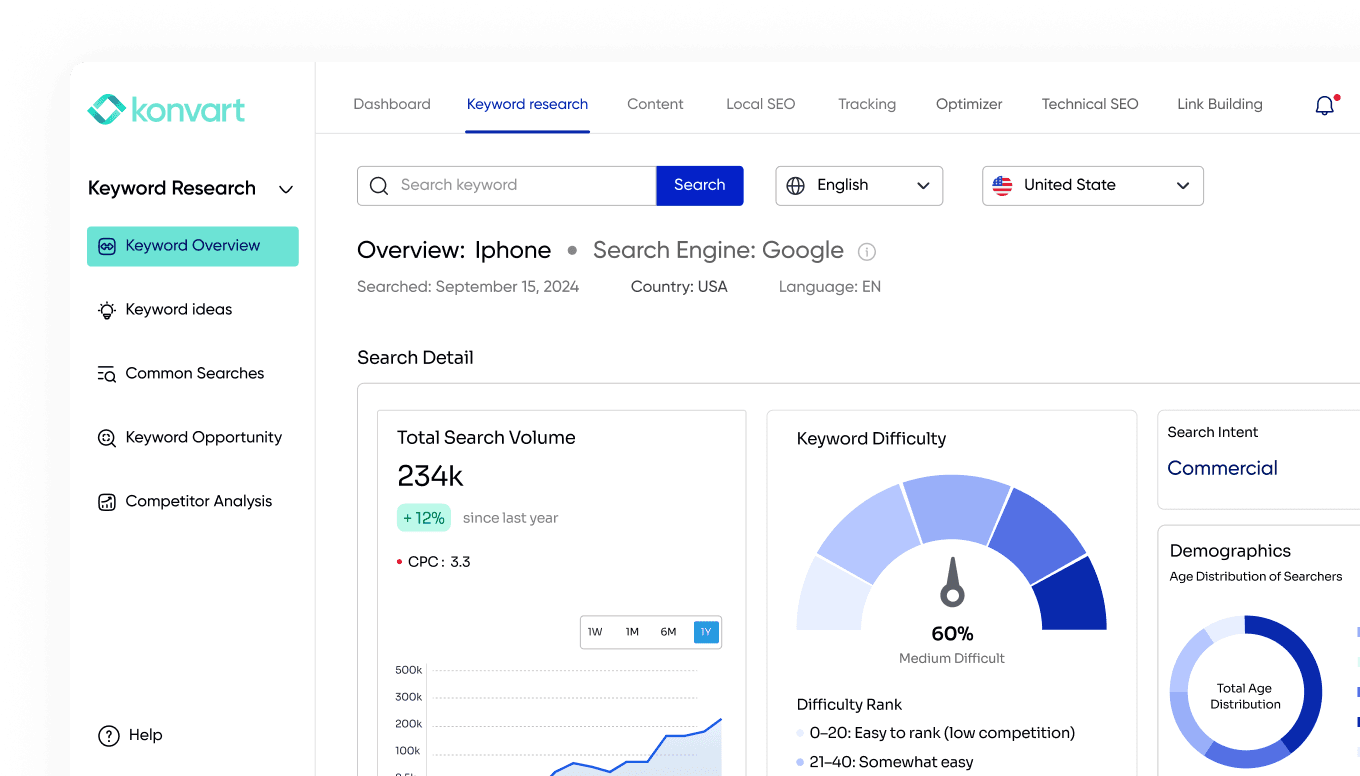
Better still, Konvart’s Optimizer can handle keyword research for you to recommend the right terms to focus on.
Additionally, it considers your commercial objectives, business type, audience, product/services, and competitors during the keyword research, clustering, and selection process.
Search Intent Analysis
Understanding search intent is one of the most important parts of modern SEO.
AI excels at analyzing search results to determine whether users are primarily looking for:
- Information.
- Comparisons.
- Products.
- Services.
- Reviews.
- Definitions.
- Step-by-step instructions.
It can also identify the follow-up questions users frequently ask, helping marketers create content that addresses the broader problem rather than a single query.
Content Briefs
One of the most valuable applications of AI is creating content briefs.
Before writing begins, if you’re using a tool with access to search results (most LLMs have access), you can get a list of competitors. However, in most cases, LLMs guess the headings that would be within each competitor, so the brief might not be relevant.
Here, Konvart excels because it crawls each competitor to understand what they cover to be better than they have, considers related searches and people also ask from the search result alongside the search intent to determine what competitors might be missing, then pulls it all together into one document alongside guidance notes for each heading, terms to include, and more, so that writers receive a structured brief that explains exactly what the article should cover.
Technical SEO Audits
Site audits can be easily carried out using SEO tools. The purpose of AI here can be in fixing the issues found by the crawlers. Konvart’s Optimizer can also fix some technical SEO issues across several site types, including WordPress and Shopify.
Content Optimization
If AI has access to your brand style and SERP data, it can create a good, well-optimized first draft. Then you can make it better with unique examples. Another area AI can be used in SEO content is optimizing existing content.
Konvart Optimizer helps here as well by reviewing your pages to find those that require just a little optimization to get to the top 3, checking against top competitors, and implementing what needs to be done, including adding missing topics, headings, entities, and more
SEO Strategy
Developing an SEO strategy requires understanding:
- business goals,
- target customers,
- competitive positioning,
- available resources,
- commercial priorities,
- and long-term growth objectives.
For example, an AI system may recommend creating content around a high-volume keyword because it appears to be an attractive opportunity.
An experienced SEO professional might ignore it because the traffic has little commercial intent or doesn’t align with the company’s products.
Strategy is ultimately about deciding what not to do as much as what to do.
That said, you can provide some of that data to AI to cut down the time in that process.
Original Research
One of the biggest limitations of generative AI is that it cannot create genuinely original research.
It can summarize existing information.
It can identify patterns.
It can explain concepts.
But it cannot conduct experiments, interview customers, analyze proprietary datasets, or publish findings that have never existed before.
And with AI being used to create most of the content on the web these days, you need original research to stand out.
Examples include:
- industry surveys,
- product benchmarks,
- proprietary datasets,
- customer research,
- case studies,
- experiments,
- and internal studies.
Our Konvart AI Overview Citation Study is one example of this. We tested optimization patterns across multiple queries to identify characteristics that consistently appeared in pages cited by AI Overviews.
This type of content is difficult for competitors and AI to replicate.
Brand Messaging
Every successful brand has a unique perspective.
AI doesn’t.
Although AI can imitate different writing styles, it doesn’t understand:
- Why your company exists,
- What differentiates your products,
- who your ideal customers are,
- or what position you want to occupy in the market.
Those decisions require leadership, experience, and an understanding of the business.
The Best AI SEO Tools
There are several AI SEO tools on the market.
Rather than comparing dozens of AI tools for SEO feature by feature, it’s more useful to understand which tool is best suited to each stage of SEO.
Best All-in-One AI SEO Platform
An all-in-one platform brings together multiple workflows, including keyword research, technical SEO, content optimization, competitor analysis, rank tracking, and reporting, within a single interface.
For businesses managing SEO at scale, an integrated platform often provides a more efficient workflow than assembling several standalone tools.
Here, Konvart is the best, particularly the Konvart Optimizer.
Best for: SEO teams, agencies, and growing businesses.
Best AI Tool for Keyword Research
Keyword research platforms usually provide data only or include AI in addition to data to:
- identify keyword opportunities,
- cluster search intent,
- discover semantic relationships,
- and uncover competitor gaps.
However, some tools, e.g., ChatGPT, cannot provide data – they can only provide suggestions based on your initial term.
Konvart focuses on data rather than keyword suggestions. Data based on the number of people searching for the term, related terms, trend over 12 months, search difficulty based on competitors’ ranking, and your Google Search Console data to suggest opportunities. Based on that data, it then helps you cluster keywords and connect them using the Optimizer. A few other tools, like SurferSEO (Topic research tool), can also help.
Best AI Tool for Content Optimization
Content optimization provides recommendations that cover
- missing entities,
- topical gaps,
- heading structure,
- internal links,
- readability,
- schema,
- and content freshness.
Several tools exist on the market for this, including Konvart (Content Editor), SurferSEO, and Fraise.
Note that when choosing a tool here, it should be able to handle SERP analysis; that means suggestions should not be based solely on what AI thinks is good, but on what is right based on competitor use and the keyword.
Best AI Tool for Technical SEO
Technical SEO platforms use AI to prioritize issues rather than simply listing them.
Instead of overwhelming users with hundreds of warnings, modern platforms increasingly estimate:
- likely SEO impact,
- implementation effort,
- affected pages,
- and suggested fixes (or help fix them).
Although most SEO tools provide a prioritized list, they don’t help with the fixes. Konvart Optimizer can help fix the issues.
Best AI Tool for AI Search Visibility
One of the newest categories of SEO software focuses on Answer Engine Optimization (AEO) and AI search visibility.
These platforms help businesses understand how they appear in AI-powered search experiences by monitoring AI citations, tracking brand visibility, and identifying competitors that are referenced in AI-generated answers.
As AI search becomes more common, measuring visibility beyond traditional rankings is likely to become an increasingly important part of SEO reporting.
When it comes to accuracy and value for money, Konvart’s AEO tool wins here. Unlike other tools that charge around $200 per platform (e.g., ChatGPT) per brand, Konvart charges as little as $27 per month to cover AI visibility for your brand (and up to 5 other brands). It provides the queries you are cited in, opportunities, accurate traffic numbers and page counts, share of voice, hit rate, and trends over time.
AI SEO Tools Comparison
Rather than asking “Which AI SEO tool is best?”, a better question is: “Which tool is best for the way my team works?”
The comparison below highlights the strengths of some of the most popular AI SEO platforms
| Feature | Konvart | Semrush | Ahrefs | Surfer SEO | Clearscope | Jasper |
| Keyword Research | ✅ | ✅ | ✅ | ✅ | ❌ | ❌ |
| Keyword Clustering | ✅ | Limited | Limited | ❌ | ❌ | ❌ |
| Content Briefs | ✅ | Limited | ❌ | ✅ | ✅ | ❌ |
| Content Optimization | ✅ | Limited | Limited | ✅ | ✅ | ❌ |
| AI Writing | ✅ | Limited | ❌ | Limited | ❌ | ✅ |
| Technical SEO Fixes | ✅ | ❌ | ✅ | ❌ | ❌ | ❌ |
| Rank Tracking | ✅ | ✅ | ✅ | ❌ | ❌ | ❌ |
| AI Visibility Tracking | ✅ | ✅ | ✅ | Limited | ❌ | ❌ |
| Competitor AI Visibility | ✅ | ✅ | ❌ | ❌ | ❌ | ❌ |
Should You Use One Tool or Several?
There’s no universal answer.
An agency managing multiple clients may benefit from a comprehensive platform that combines keyword research, content optimization, technical SEO, reporting, and AI visibility tracking in one place.
A freelance content writer, on the other hand, may only need an AI writing assistant alongside a content optimization platform.
Every additional platform introduces another interface to learn, another subscription to manage, and another dataset to reconcile.
Whenever possible, choose tools that complement each other rather than tools that provide features you need but are not available in your current toolset, or one that can replace several tools in your current set.
Common AI SEO Mistakes
Artificial intelligence can dramatically improve productivity. However, many businesses fail to see meaningful results because they adopt AI without changing their processes. The following mistakes are among the most common.
Publishing AI Content Without Editing
AI can generate content, but some of it may be inaccurate. Always fact-check, edit, and improve AI-generated drafts before publishing. And remember what I mentioned earlier regarding adding your own unique insights.
Believing AI Scores Are the Goal
Many optimization tools provide content scores. Even before LLMs were popular, we were used to seeing things like grammar scores from grammar checkers, keyword density or term usage from SEO tools, et.c. Scores like these can be useful indicators, but should never become the objective. The goal should be to create the best page on the internet for that topic, not to achieve a score of 100.
Ignoring AI Search
Many businesses still measure success using rankings alone. You must start monitoring:
- AI visibility,
- AI citations,
- brand mentions,
- and share of voice.
Not Considering Changes to AI
In line with the EU Article 50(2) Code of Practice on Transparency, Anthropic decided to begin adding watermarks to AI-generated content.
Although Google could already tell when content was generated by AI and had stated that it did not care about the source but about quality, its human raters’ guidelines said the opposite (in summary, AI content could be marked down if noticed).
Now, with this change from Anthropic, Google might use it in the future as a tie-breaker like Core Web Vitals. That means when two equally good content are in the SERP, the human-written one might be ranked above the one with a very high AI presence and little to no human content.
To ensure your AI-written content ranks, consider the SERP or use an AI writer that does so. Konvart’s AI Writers do. Every heading and content is based on SERP analysis. Then, when the content is done, include your own insights, e.g., case studies and examples from your own work. That would ensure you still rank high regardless.
In addition to Anthropic and Claude, OpenAI and other LLMs might make changes that affect how AI-generated content is perceived, and Google might also update its algorithm. Keep up to date with such changes so you can adapt quickly.
Key Takeaways
AI is here to stay in SEO. The goal remains the same: helping people find trustworthy, useful information. We just need to ensure we use AI correctly to meet those goals.
The businesses that will benefit most from AI won’t be those producing the largest volume of AI-generated content. They’ll be the ones using AI to uncover better opportunities and save time and effort.
AI should be viewed as an amplifier. It makes good SEO teams faster, but it doesn’t replace what makes them good in the first place.