AI search has changed how people discover information.
Instead of showing users a list of webpages and asking them to find the answer themselves, search engines now generate AI-powered summaries that answer questions directly within the search results. These summaries, known as AI Overviews, combine information from multiple sources to help users understand a topic more quickly.
For users, that’s a better search experience.
For businesses, dealing with more zero-click searches is now a reality, especially for informational searches.
Ranking first is still valuable, but it’s no longer the only way to appear prominently in search results. Today, pages that provide the clearest, most trustworthy, and most comprehensive answers can be cited directly within AI Overviews, even when they aren’t the highest-ranking organic result.
The good news is that AI Overviews don’t require an entirely new SEO strategy. Google’s advice remains largely the same: create helpful content, demonstrate expertise, and build technically sound websites. However, after months of testing, we’ve found that some tactics appear to increase the likelihood of being cited more consistently than others.
In this guide, we’ll explain what AI Overviews are, how they work, what we’ve learned from our own testing, and how you can optimize your content for AI overviews in search.
What are AI Overviews?
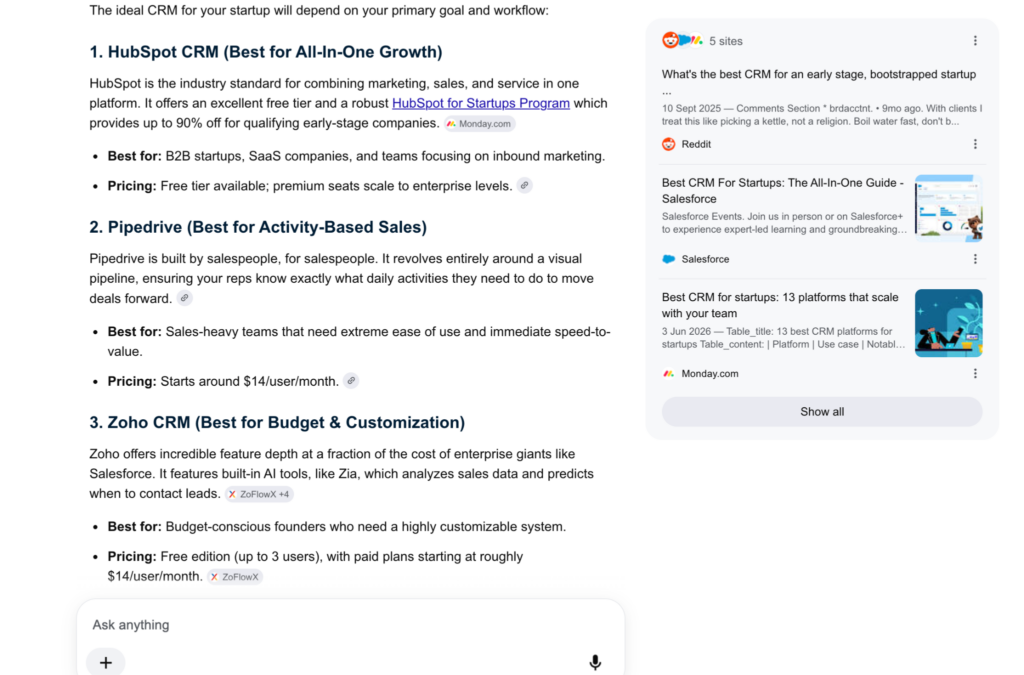
AI Overviews are AI-generated summaries that appear within search results to answer a user’s question directly.
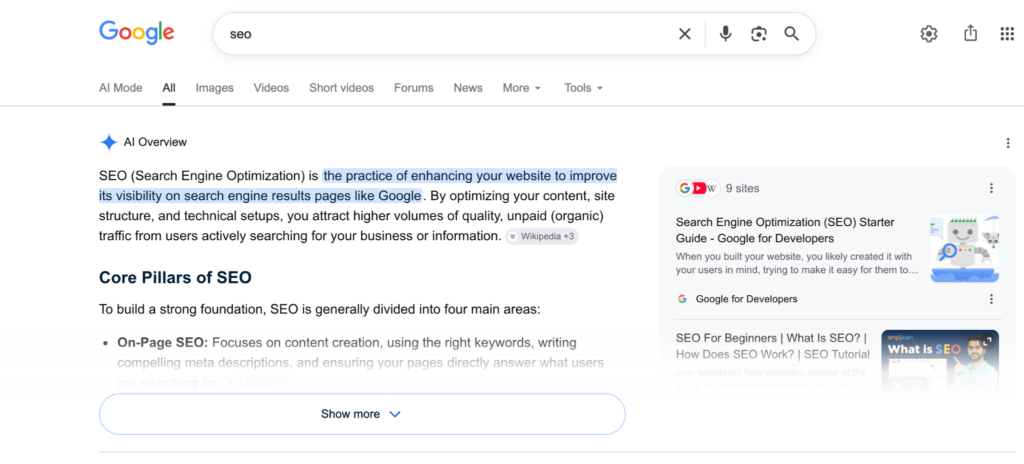
Rather than displaying only a list of webpages, the search engine analyzes multiple sources, identifies the most relevant information, and generates a concise response. Alongside that response, it typically includes links to the webpages that contributed information, allowing users to explore topics in greater depth.
Imagine someone searching:
How often should you update blog content?
Instead of clicking through several articles, they might immediately see an explanation covering recommended update frequencies, factors that influence content freshness, and links to trusted sources for further reading.
While the exact layout varies depending on the query, AI Overviews commonly include:
- A concise AI-generated summary
- Links to supporting sources
- Bullet points or numbered lists
- Tables or comparison cards where appropriate
- Related questions that help users explore the topic further
Not every search generates an AI Overview.
Search engines determine whether generating one is likely to improve the search experience based on factors such as the complexity of the query, the availability of reliable information, and their confidence in producing an accurate response.
AI Overviews vs Traditional Search Results
Traditional organic search results present users with a list of webpages.
Users compare titles, meta descriptions, and URLs before deciding which page is most likely to answer their question.
AI Overviews change that process.
Instead of asking users to evaluate multiple webpages themselves, the search engine performs much of that work automatically by synthesizing information from several sources into a single answer.
That doesn’t mean traditional rankings have disappeared.
A typical search results page might still include:
- Sponsored advertisements
- AI Overviews
- Organic search results
- Featured Snippets
- Videos
- Images
- Local listings
- Shopping results
What has changed is the definition of visibility.
Ten years ago, success often meant ranking in the first organic position.
Today, success increasingly means becoming one of the sources the AI trusts enough to cite.
AI Overviews vs Featured Snippets
Because both appear in search results, AI Overviews are often confused with Featured Snippets.
Although they share some similarities, they work very differently.
| Featured Snippets | AI Overviews |
| Usually extracts content from one webpage | Gets information from multiple webpages |
| Often quote text directly | Generate a new summary |
| Single source | Multiple cited sources |
| Static extraction | Dynamic AI-generated response |
| Focus on one answer | Combine several perspectives |
A Featured Snippet typically extracts one passage directly from a webpage.
An AI Overview, on the other hand, retrieves information from multiple sources before generating an entirely new explanation.
Optimizing for Featured Snippets often means creating one highly quotable paragraph.
Optimizing for AI Overviews means creating content that deserves to become part of a broader answer.
What AI Overviews Bring
AI Overviews aren’t simply another search feature. For SEO professionals, marketers, and publishers, that changes how success should be measured.
1. Brand Awareness
Being cited within an AI Overview places your brand near the top of the search results, often above traditional organic listings.
Even if users don’t click through to your website immediately, your brand is introduced early in their search journey.
That visibility can improve brand awareness, credibility, and recall.
2. More Zero-Click Searches
AI Overviews also contribute to the growing number of zero-click searches.
Someone searching:
What is technical SEO?
may receive enough information from the AI Overview without visiting any website.
For publishers, this can reduce traffic for some informational queries.
3. Authority Becomes More Important
One of the most interesting things about AI Overviews is that they don’t simply cite the highest-ranking page.
Instead, they appear to prioritize content that demonstrates:
- Expertise
- Relevance
- Accuracy
- Trustworthiness
- Comprehensive topic coverage
During our own testing, we repeatedly saw pages outside the top three organic positions appear within AI Overviews because they answered the user’s question more effectively.
Traditional rankings still matter, but being the clearest answer can sometimes be just as important as being the highest-ranking result.
4. Search Intent Matters More Than Ever
Modern search engines attempt to understand intent.
When someone searches:
Best CRM for startups
They may also be asking:
- Which CRM is easiest to use?
- Which CRM is most affordable?
- Which CRM scales with growth?
- Which CRM integrates with other tools?
AI systems attempt to answer all of those related questions within a single response.
As a result, content that satisfies the broader intent behind a search is often more useful than content focused narrowly on a single keyword.
How AI Overviews Work
Although the underlying technology is extremely sophisticated, the overall process can be understood in five stages.
1. Understanding the Query
Everything begins with the user’s search.
The system attempts to understand what the user is actually trying to accomplish.
For example, these searches all express essentially the same intent:
- Best CRM for startups
- Which CRM should a startup choose?
- Startup CRM recommendations
Although the wording differs, the underlying question is the same.
AI systems recognize those relationships before retrieving information.
2. Query Fan-Out
One of the biggest differences between AI Overviews and traditional search is query fan-out.
Rather than performing one search, the system may perform dozens of related searches behind the scenes.
For example, if someone searches:
How do I optimize for AI Overviews?
The system may also explore related questions such as:
- What are AI Overviews?
- How do AI Overviews work?
- What influences AI Overview citations?
- How does Google generate AI Overviews?
- What SEO techniques improve AI visibility?
- How do you track AI Overview performance?
Each of those searches helps the system build a more complete understanding of the topic before generating a final answer.
That’s one reason AI Overviews often answer several related questions simultaneously rather than addressing only the exact query the user entered.
3. Retrieving Relevant Sources
Once the system understands the topic, it retrieves webpages likely to contain useful information.
Importantly, it isn’t limited to the highest-ranking page.
Instead, it evaluates numerous sources that collectively provide the best answer.
Among the signals that appear to influence retrieval are:
- Relevance to the query
- Topical authority
- Freshness
- Technical accessibility
- Website reputation
- Evidence of expertise
Before any of those factors matter, however, one requirement comes first:
Your content must be crawlable and indexable.
If search engines can’t access your content, they can’t use it in an AI Overview.
4. Evaluating Information
After retrieving relevant sources, the AI doesn’t simply copy the highest-ranking page.
Instead, it evaluates the information it has collected to determine which pieces are the most accurate, useful, and relevant to the user’s query.
During this stage, the system appears to consider questions such as:
- Which sources agree with each other?
- Which explanations are the clearest?
- Which facts appear trustworthy?
- Is the information up to date?
- Does one source provide a unique context or examples?
Rather than reproducing paragraphs verbatim, AI Overviews synthesize information from multiple sources into a new response.
This is one reason why simply copying information that already exists rarely leads to long-term success. If your page says exactly what every other page says, there’s little reason for an AI system to prefer it over another source.
The pages that tend to stand out usually contribute something extra, whether that’s a clearer explanation, better organization, original data, or first-hand expertise.
5. Generating the AI Overview
Once the system has gathered and evaluated relevant information, it generates the Overview itself.
The response is written specifically for the user’s query rather than copied directly from any one source. Alongside the generated answer, Google typically includes links to several webpages that contributed information, allowing users to explore the topic further.
Those citations are important.
They’re Google’s way of showing users where information came from while allowing publishers to earn visibility, authority, and potentially traffic.
From an SEO perspective, the objective isn’t simply to rank first anymore.
It’s to become one of the sources Google trusts enough to cite.
How Google Chooses Sources for AI Overviews
Google has published official guidance for optimizing websites for AI Overviews and AI Mode. Much of that guidance reinforces established SEO best practices, such as creating helpful content, maintaining strong technical SEO, and ensuring pages are crawlable.
Those fundamentals are essential. Without them, your pages are unlikely to perform well in either traditional search or AI-powered search experiences.
However, as with traditional SEO, following Google’s recommendations doesn’t guarantee that your content will be cited in an AI Overview.
That raised an important question for us.
Once those fundamentals are in place, what distinguishes pages that are consistently cited in AI Overviews from those that aren’t?
To answer that question, we conducted our own testing.
Rather than trying to reverse engineer Google’s ranking systems, we focused on the content itself. We wanted to understand whether pages that repeatedly appeared in AI Overviews shared common characteristics in their structure, writing, and presentation.
The Konvart AI Overview Citation Study
Most articles about AI Overviews repeat the same advice:
- Create helpful content.
- Build backlinks.
- Follow SEO best practices.
While those recommendations are valuable, they don’t explain why one page is cited while another isn’t.
We wanted to understand whether there were recurring patterns among pages that consistently appeared in AI Overviews.
So instead of relying solely on documentation or industry opinion, we conducted our own testing.
Why We Conducted the Study
As part of building Konvart, we spend a significant amount of time helping businesses improve their visibility in both traditional search and AI-powered search experiences.
In doing so, the question “What actually increases the chances of being cited?” has been asked more times than we can count.
We wanted to understand whether specific content patterns consistently influenced AI Overview citations.
Methodology
Over 12 months, 14 members of the Konvart team tested content across multiple search queries that generated AI Overviews.
We monitored whether pages were cited within the AI Overview itself.
Throughout the testing process, we experimented with factors including:
- Information architecture
- Heading structure
- Answer placement
- Lists
- Tables
- Topic coverage
- Section order
- Content depth
- Formatting
After each round of testing, we refined the content based on our observations and repeated the process with additional queries.
The patterns we found appeared consistently enough throughout our testing that we now incorporate them into our own optimization process.
Key Finding
One observation stood out above everything else.
Pages were 70% more likely to be cited when they mirrored the information architecture of the AI Overview while expanding on it with more comprehensive, original information.
That doesn’t mean copying Google’s wording.
It means understanding how the information is organized and creating a better version of that experience.
The following patterns build on that observation.
The Patterns We Observed
A reminder before the list: these are recurring observations from our testing across two niches, not confirmed ranking factors. They held often enough that we now build them into our own process, but structure never worked in isolation. The rest of a page’s SEO still had to be sound.
Pattern 1: Mirror the AI Overview’s information architecture
What we observed: Across many queries, pages were cited more frequently when they organized information in a way similar to the AI Overview already shown for that query. The wording, the examples, and the content differed, but the overall structure was often the same.
Pages that mirrored the overview’s structure were cited roughly 70% more often than those that didn’t, though only when their broader SEO was also in order.
Suppose the AI Overview for “UK spouse visa” covers: what a spouse visa is, eligibility requirements as bullet points, a fee table, required documents, processing times, and an FAQ. The pages that performed best covered those same topics in a similar order. Pages that skipped major sections or presented everything as long-form prose appeared far less often.
Why we think it works: Google’s systems already treat that architecture as satisfying the user’s intent. When your page is organized the same way, retrieval systems can identify relevant sections and synthesize them more easily; you’re reducing the restructuring the AI has to do.
How to apply it: Search your target keyword, study the AI Overview, and list every major topic it covers. Build your page around those topics, then add more depth, examples, visuals, and first-hand expertise than the Overview provides. The objective isn’t to imitate Google’s answer. It’s to create the page Google wishes it could summarize.
Pattern 2: Lead with the answer, cut the warm-up
What we observed: Pages that answered the primary question in the opening lines outperformed pages that spent several paragraphs introducing the topic. Pages that “warmed up” for hundreds of words before saying anything useful were cited least consistently.
Why we think it works: AI systems need to identify the core answer before they can summarize it. A page that states the answer immediately requires less interpretation than one that gradually works toward it. Density is rewarded by AI systems and by readers.
How to apply it: Instead of answering “What are AI Overviews” with “Search engine optimization has changed dramatically over the years…”, open with the answer: “AI Overviews are AI-generated summaries that combine information from multiple sources to answer users’ questions directly in search results.” Then expand into context and examples. Before publishing, check each paragraph: does it help answer the user’s question, or introduce genuinely useful context? If not, shorten or cut it.
Pattern 3: Match the overview’s scope, then answer the follow-ups
What we observed: The weakest pages either covered too little or tried to cover everything imaginable. The best ones matched the Overview’s scope first, then expanded. If the Overview answered six questions, successful pages answered those same six before adding more.
They also anticipated follow-up questions. A page about canonical tags that stops after explaining what a canonical tag is is less useful than one that also answers: When should you use one? How do you implement it? Can multiple pages have the same canonical URL? What are common mistakes? How do you check whether it’s working? Does it affect rankings? The pages that performed well rarely answered a single question—they solved the broader problem behind the search.
Why we think it works: This matches how AI systems fan a query out into related sub-questions. Covering the full cluster makes your page useful across more of those sub-searches, while matching the Overview’s scope first keeps it focused rather than sprawling.
How to apply it: List the questions the Overview answers, plus the obvious follow-ups a consumer would have next. Answer all of them before introducing additional insights.
Pattern 4: Format structured information as lists and tables
What we observed: Requirements, benefits, steps, features, and eligibility criteria frequently appeared as lists inside Overviews. When our pages presented that kind of information as bulleted or numbered lists rather than dense paragraphs, citations became more consistent. For anything comparative, tables consistently outperformed paragraphs.
Why we think it works: The formatting isn’t the reason on its own. Lists and tables make key information easier to identify and synthesize for both readers and AI systems processing the page.
How to apply it: Use lists for anything that can be enumerated, and tables whenever users are choosing among options. If a section is helping someone compare, a comparison table is almost always the clearest format.
Pattern 5: Make each section a self-contained, well-labeled answer
What we observed: The best-performing pages rarely relied on context from earlier sections. Each heading answered its question almost independently. For example, a section titled “How to Implement a Canonical Tag” explained the implementation process completely within that section, without requiring readers to understand the previous 500 words.
Why we think it works: When AI systems retrieve information, they don’t necessarily use an entire page. They often retrieve individual passages.
A section that clearly answers one question is easier to retrieve and incorporate into an AI-generated response than one that depends heavily on surrounding context.
How to apply it: As you write, ask yourself:
“If Google only used this section, would it completely answer the heading?”
If the answer is no, rewrite it.
Think of every H2 and H3 as an opportunity to become the source for a specific answer.
Pattern 6: Use descriptive headings
What we observed: We consistently saw stronger results from pages that used highly descriptive headings rather than vague labels. For example:
Canonical Tags → What Is a Canonical Tag?
Implementation → How to Implement a Canonical Tag
Common Issues → Common Canonical Tag Mistakes and How to Fix Them
Why we think it works: Descriptive headings immediately communicate what follows. That benefits readers, but it also helps search engines understand the purpose of each section without relying solely on surrounding text.
How to apply it: Write headings that make sense in isolation, communicating the topic, the entity, and the user’s question without extra context. Treat every H2 and H3 as a chance to become the source for a specific answer.
Pattern 7: Add original value that the overview doesn’t have
What we observed: Pages that repeated publicly available information rarely stood out. The most consistently cited pages added something new: original examples, practical advice, first-hand experience, expert commentary, proprietary data, or downloadable resources.
Why we think it works: AI systems already have access to thousands of pages saying the same thing. If your page says exactly what every other page says, there’s little reason to prefer it. Original information gives the system a reason to reference you specifically.
How to apply it: Ask: what can only my company publish? For us, that’s AI Overview testing, keyword research, content optimization studies, backlink analysis, and AI visibility reports; insights competitors can’t easily copy.
Pattern 8: Keep SEO strong
What we observed: Although URLs that are not on the first page were cited, technical SEO was still a strong factor, especially content extractability.
Why we think it works: AI needs to be able to read the content on your page to cite it. Luckily, Google can read most types of content, but the speed of your page and the ability to read text on it were still important to AI overviews.
How to apply it: Improve your technical SEO while keeping other parts of SEO, e.g., link building, strong. Regularly review:
- Robots.txt
- XML sitemaps
- Canonical tags
- Noindex directives
- Internal linking
- Crawl errors
If Google can’t crawl or index your page, it can’t use it in an AI Overview.
Additional AI Overview Optimization Best Practices
Our study focused primarily on how content structure and information architecture influenced AI Overview citations.
However, content structure is only one part of the picture.
Like traditional search, AI Overviews are influenced by broader SEO signals that determine whether search engines can discover, understand, trust, and confidently reference your content.
The following recommendations are based on Google’s guidance and established SEO best practices.
Build Topical Authority
One excellent article is rarely enough.
Search engines increasingly evaluate websites based on the depth of their expertise across an entire subject.
For example, if you want to establish authority around AI search, publish related resources covering:
- AI Overviews
- AI Mode
- Answer Engine Optimization (AEO)
- Generative Engine Optimization (GEO)
- AI crawlers
- Entity SEO
- Structured data
- AI referral traffic
When those pages are connected through thoughtful internal linking, they reinforce each other’s authority.
Strengthen Your Internal Linking
Internal links help search engines understand the relationship between your content.
More importantly, they reinforce topical clusters.
For example, this guide should naturally link to articles covering:
- Structured data
- Technical SEO
- Keyword research
- Content optimization
- Link building
- AI Mode
- AEO
Likewise, those pages should link back here where relevant.
Strong internal linking helps distribute authority while making your content easier to discover and navigate.
Use Structured Data Where Appropriate
Schema doesn’t guarantee inclusion in AI Overviews.
However, it helps search engines understand your content more accurately.
Depending on the page, consider implementing:
- Article
- FAQ
- Organization
- Product
- HowTo
- Review
- Breadcrumb
- Author
The goal isn’t to add every available schema type.
It’s to describe your content as accurately as possible.
Earn High-Quality Backlinks and Brand Mentions
Authority extends beyond your own website.
Backlinks remain one of the strongest indicators that other websites trust your content.
Similarly, unlinked brand mentions across reputable publications can reinforce your authority.
Demonstrate Experience and Expertise
Google’s guidance consistently emphasizes the importance of creating content that demonstrates genuine experience and expertise.
Whenever possible:
- Share first-hand experience.
- Include expert commentary.
- Cite reputable sources.
- Explain complex topics clearly.
- Update content when information changes.
Readers trust content written by people who have done the work.
AI systems appear to value that too.
Prioritize User Experience
Finally, don’t overlook the fundamentals.
Fast-loading pages, responsive design, intuitive navigation, and accessible content all contribute to a better experience.
While these factors alone won’t guarantee AI Overview citations, they help create the kind of high-quality pages search engines want to recommend.
How to Measure AI Overview Performance
One of the biggest challenges with AI Overviews is measuring success.
Unlike traditional SEO, where rankings are relatively easy to monitor, AI Overviews can vary by location, device, search history, language, and even over short periods. A page may be cited for one variation of a query but not another.
Also, Google does not provide a lot of data in this regard.
As a result, measuring AI visibility requires looking beyond keyword rankings alone.
Use Search Console and Bing Webmaster Tools
Google Search Console includes a Generative AI features performance report, allowing site owners to monitor impressions and clicks generated through Google’s AI-powered search experiences. You can also segment the data by page, country, device, and date.
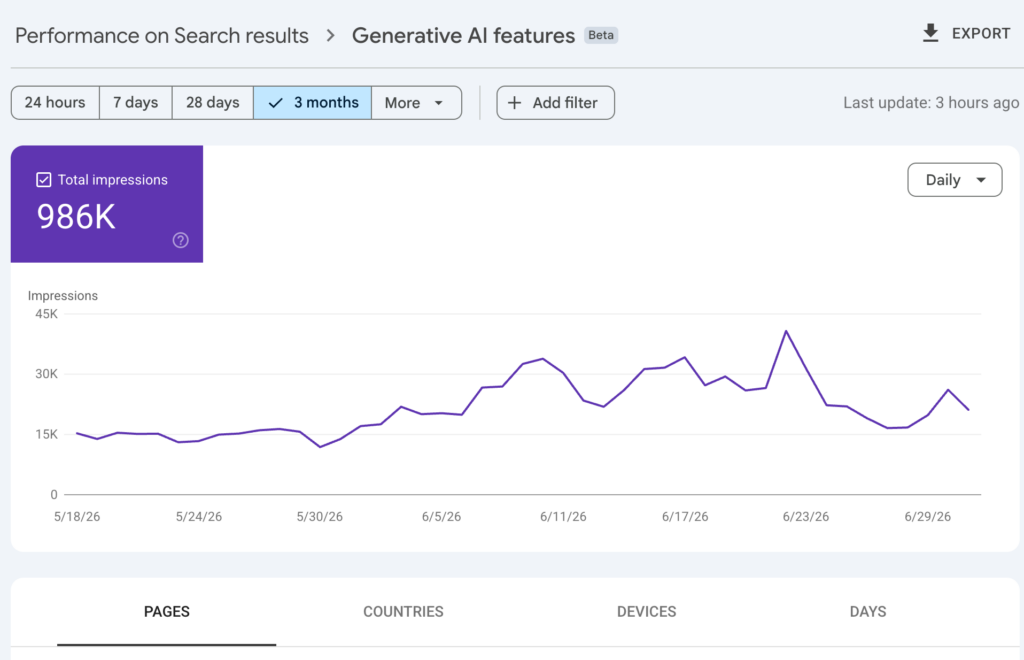
However, the report doesn’t show which queries triggered AI Overviews, whether your page was cited in a specific AI Overview, your citation share, or which competing pages were cited alongside yours. As a result, while it provides useful performance metrics, it offers limited visibility into why your content was surfaced or how it compares to competitors.
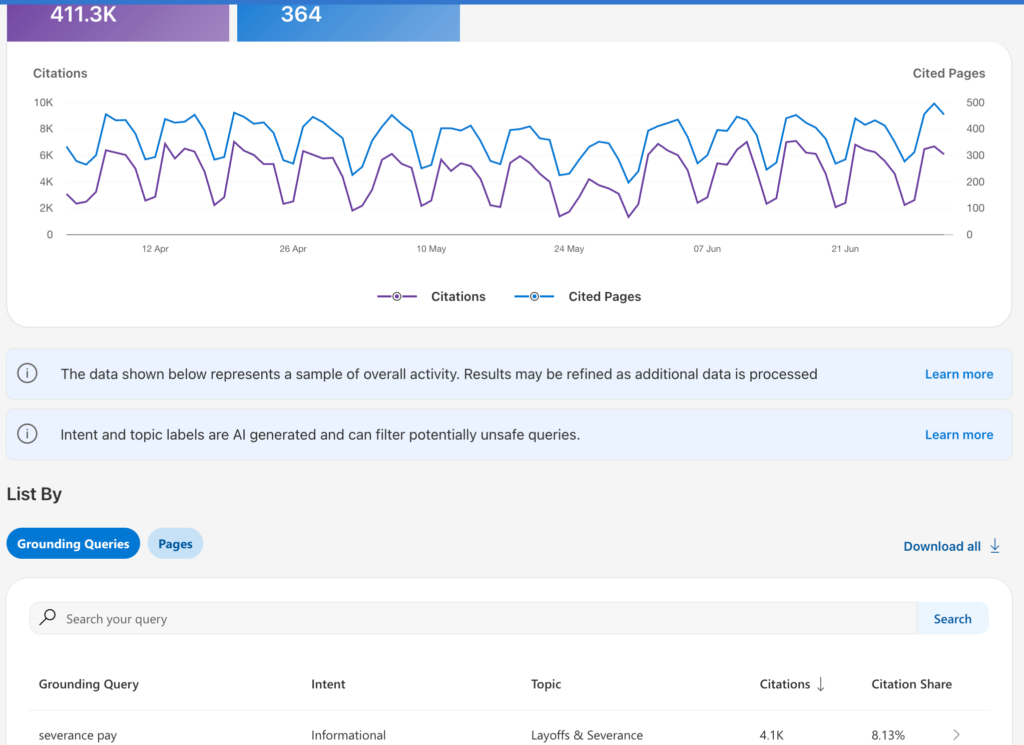
Microsoft is different. In February 2026, it launched an AI Performance report in Bing Webmaster Tools. It tracks Microsoft’s own AI surfaces: Microsoft Copilot, AI-generated summaries in Bing, and select partner integrations. It does not report on Google AI Overviews, ChatGPT, Perplexity, Claude, or Gemini. So it’s a window into Microsoft’s ecosystem, not AI search as a whole.
Within that scope, it surfaces data that was previously invisible:
- Total citations: how often your site appears as a source in AI-generated answers over a selected period
- Average cited pages: the daily average number of unique URLs from your site referenced across AI answers
- Grounding queries: the phrases the AI generated internally to retrieve your content, which are not the same as the user’s original prompt
- Page-level citation activity: which specific URLs are cited and how often
- Visibility trends: how citation activity rises or falls over time
- Citation share: your citations vs competitors
Monitor AI Visibility with Konvart
Konvart’s Answer Engine Optimization (AEO) and Rank tracking tools are designed to help you understand how your brand performs across AI overviews and other AI search platforms.
In the rank tracker, you see if/when you rank for AI overviews.
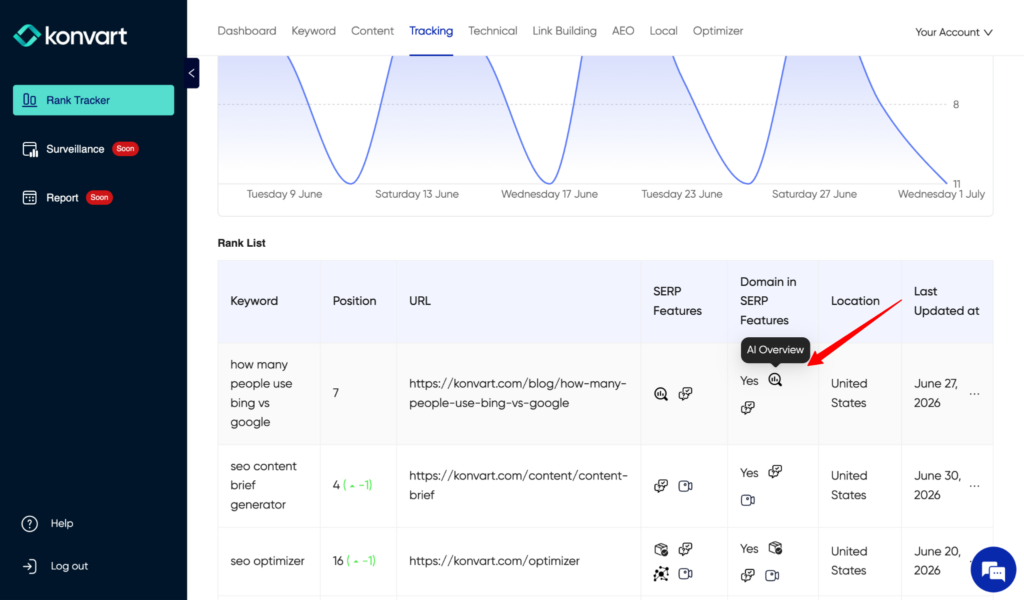
If there is an AI overview for your query, you will see it in the “SERP Features” column. If your page/domain is cited in the AI Overview response, you will see it in “Domain in SERP Features” with the AI overview icon alongside “Yes” to indicate you are there.
To track more AI searches, you need to use the Konvart AEO tool. This tool identifies the real-world queries that trigger AI answers for your pages and monitors whether your website is cited in other search systems, including ChatGPT and Claude.
For every tracked page, you can:
- See whether your brand or URL is cited in AI-generated answers.
- View every website cited alongside yours.
- Identify competitors that consistently appear in AI results.
- Discover opportunities where competitors are being cited, but your content isn’t.
Optimize for AI Search with Konvart
AI Overviews have changed how search engines surface information, but they haven’t changed what ultimately earns visibility: content that deserves to be cited.
That means understanding your audience, creating genuinely helpful resources, demonstrating expertise, and making it easy for search engines to discover and understand your content.
The challenge is bringing all of those pieces together.
That’s where Konvart helps.
Konvart combines AI visibility insights, keyword research, content optimization, technical SEO, competitor analysis, schema recommendations, backlink intelligence, and outreach into a single platform. Instead of switching between multiple tools to understand why a page isn’t performing, you can identify opportunities, prioritize improvements, and measure your progress from one place.
Whether you’re trying to improve traditional rankings, earn more AI Overview citations, or build long-term topical authority, Konvart gives you the data and support needed to make informed decisions. Click here to sign up.
Frequently Asked Questions
Can any website appear in AI Overviews?
Yes.
There is no application process or special program.
Any publicly accessible page that search engines can crawl and index may be considered if it provides useful, trustworthy, and relevant information.
Do you need to rank first to appear?
No.
Throughout our testing, we observed numerous instances of pages outside the top 3 and 10 organic positions appearing within AI Overviews.
Ranking well helps.
However, being the clearest and most useful source matters just as much.
Does schema guarantee inclusion?
No.
Structured data helps search engines understand your content, but it doesn’t guarantee AI Overview citations.
Think of schema as supporting information rather than a shortcut.
Are backlinks still important?
Yes.
Backlinks remain one of the strongest signals of authority.
Combined with high-quality content, brand mentions, and demonstrated expertise, they help establish trust in your website.
Will AI Overviews reduce my traffic?
It depends.
Some informational searches may lead to more zero-click behavior.
However, appearing within an AI Overview can significantly increase brand exposure and establish authority before users ever visit your website.
Should I copy an AI Overview?
No.
Our testing never involved copying Google’s wording.
Instead, we mirrored the information architecture while creating substantially better content.
Think of the AI Overview as a blueprint for the questions users expect to be answered, not a template to reproduce.