People in SEO are divided about how effective AI-generated content is for SEO.
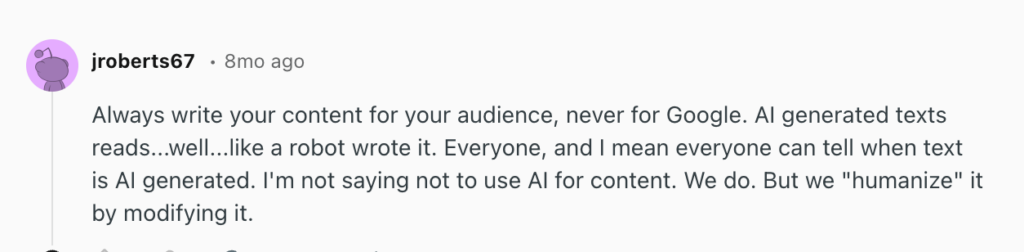
AI-generated content isn’t good if not modified:
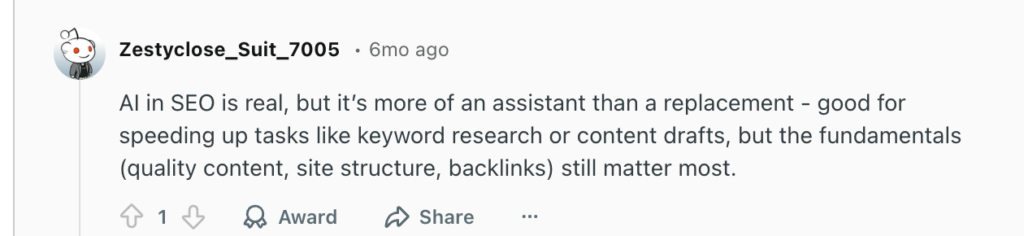
Not for content, but supporting tasks:
Google doesn’t care:
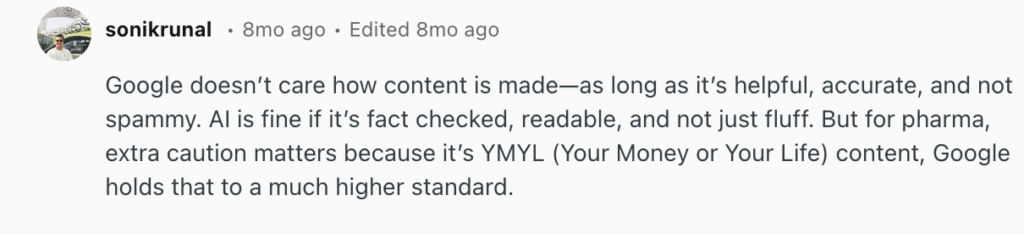
So, which is it?
We make it clear in this article by comparing what Google has said against actual results using AI-generated content.
Does AI Content Work for SEO?
Yes, AI-generated content works for SEO if you do it right.
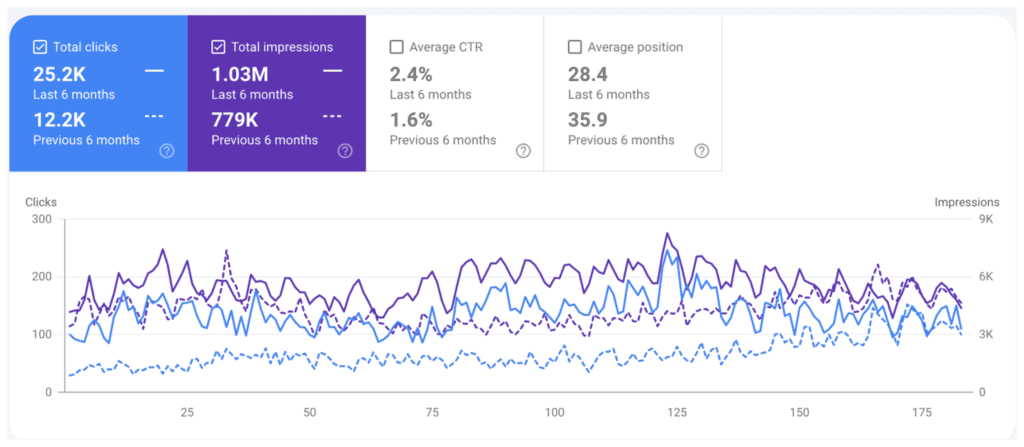
The screenshot above is from a site that used AI content within a six-month period. You can see the huge growth in clicks (about 100%). We have also seen improvements for several other sites that use Konvart.
If you are not getting results with AI, you need to ensure you are using it correctly. Before we look into that, I will show you what Google has to say about AI-generated content.
Does Google penalize AI-generated content?
To put it simply, Google doesn’t care if you use AI for your content or not. The emphasis should be on content created for humans, not necessarily content created by humans.
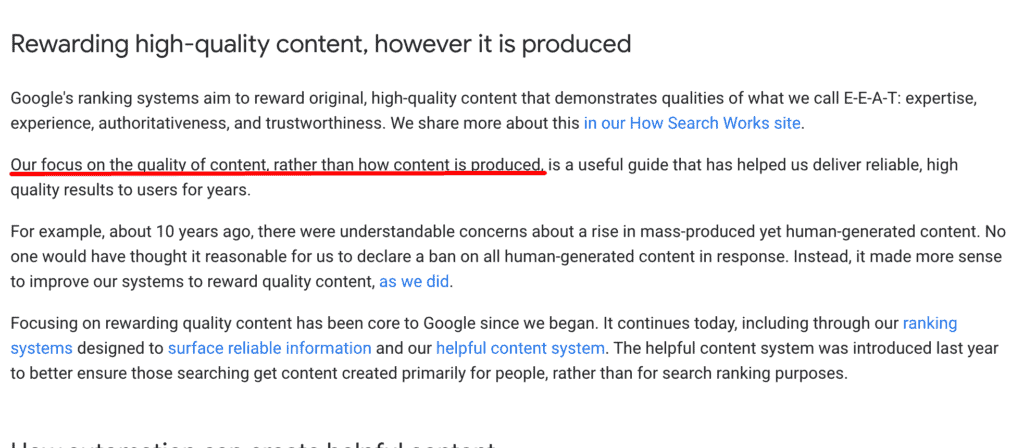
Google has stated that quality matters, not the method of creation. This means that AI-generated content is not automatically penalized, but its value hinges on its quality and relevance.
This is in line with Google’s stance over the years, which has emphasized quality content over length or anything else. Whether crafted by a human or an AI, content needs to meet Google’s quality guidelines to ensure a good user experience.
So, AI-generated content meets the same standards as content written for humans in terms of usefulness, credibility, and originality.
However, certain actions can still result in a penalty.
If you programmatically churn out content with the purpose of manipulating rankings, Google would see that as a violation of its spam policies.
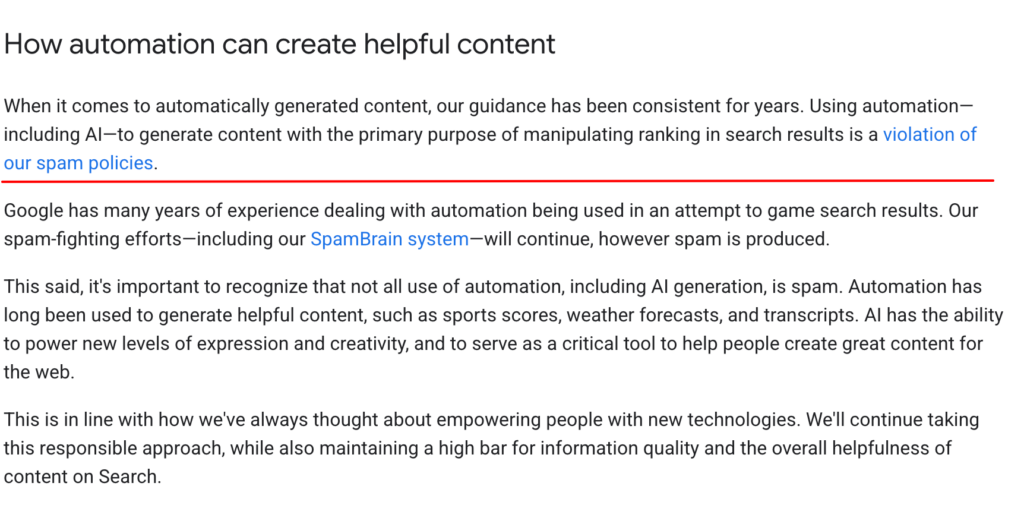
One way to prevent this is to check your publishing cadence.
It does not look human for a new site to suddenly start publishing 50 new pages a day. Sure, you can use AI tools to write the content and save time, but review them, and increase your cadence at a normal rate.
To be clear, it’s not just about the speed of publishing, but also the type of content. Google has mentioned in its quality rater guidelines that these are not acceptable:
- Producing many pages that add little to no value for website visitors compared to other pages on the web on the same topic
- Scraping the search results or other content in order to generate many pages, including things like synonymising the content you scraped or translating – basically, it’s still the same content, but you tried to make it look like it isn’t.
- Combining content from different web pages without anything original added by you or the AI
- Creating multiple sites so you can share your 50+/day content across several domains without being caught, or publishing the same topic across those many sites, so as to game the rankings
- Creating AI content that does not make sense to the reader but is filled with keywords
Google understands that AI tools can be used to create high-quality content as well as low-quality content. It’s all about the level of effort, originality, and value added to the user.
Can AI-generated content hurt my search ranking?
As mentioned, it’s about the quality of the content. Like human-written content, AI-generated content can help rankings, but it can also hurt rankings, depending on how you use it. On one hand, it offers efficiency and speed in content creation. On the flip side, there are potential risks that could impact your search ranking. I will discuss the risks below and then go into how to prevent issues.
Reduced Content Quality
AI tools have come a long way, but they aren’t infallible. One problem area is content quality. AI might churn out text that lacks depth or insight, leaving readers unsatisfied. Content that’s too general or fails to delve deeply into topics risks being dismissed by readers and search engines.
To prevent this, always put SERP analysis at the forefront of your AI content creation. In that post, I broke down how to perform SERP analysis and how to use its insights when creating content. I also showed you what tools you can use in this step.
When choosing your SEO AI writer, it’s also imperative that you choose one that is built for SEO, like Konvart AI Writer or Konvart Custom AI Writer. Both tools analyze the SERP first before writing content so as to save you time when it comes to providing value and optimizing the content.
Lack of Originality
Originality takes a back seat with AI-generated text. Machines often pull from existing sources, risking repetition or even unintentional plagiarism. Search engines love fresh perspectives and unique voices (though this can be argued), so putting out content that’s similar to what’s already out there could hurt your rankings.
What I mean by “this can be argued” is this: backlinks are still pretty key. That said, you can have the best backlinks and still not rank well if your content is horrible.
To add some originality, write with AI as the first step – your first draft. Then, edit to add your experience and insights.
Risk of Being Flagged as Low-Value
Search engines aim to deliver valuable content to users. If AI-produced material is seen as low-value, it might struggle to find favor with search algorithms. In some cases, it will not even be indexed. And if it’s indexed, lower rankings can follow if the content doesn’t hit the mark in terms of value.
To provide value, again, ensure your AI Writer is an SEO AI Writer, and choose one that can properly structure its content. Then, when reviewing your content, check that it meets all requirements in this guide for writing SEO-friendly content.
What to Consider When Using AI to Write SEO Content
There are four factors that Google’s quality raters use to rate web content.
- Effort: Did a human work to create satisfying content? This effort does not mean writing the content from scratch, but rather supporting it, e.g., by editing it to add value, designing the page, adding free tools to the page that provide value, etc. So, it’s not about a human writing everything.
- Originality: Does the content provide a unique, original view? One might say that for most industries, there’s no new content. Sure, but there might be a new angle. You can use AI to write the parts that put you at par with competitors and then edit them to add an example from your own work or experience.
- Talent or Skill: Is the author/editor skillful? This can be proven with your author bio and EEAT on the page. The goal is to provide a satisfying experience for your website visitors.
- Accuracy: Are the statements true? This is especially important for YMYL topics (your money, your life, e.g., health and finance industries). The good thing is that AI has access to the web, so it can curate information from it. The bad thing is that web content can be inaccurate, and AI can draw from that when writing your content. So, always fact-check AI-generated content before publishing.
The use of AI should not replace human touch in content creation. Here’s why: EEAT is still a big deal for SEO, and it makes no sense to attribute an article to an author who didn’t even edit it.
Therefore, when using AI-generated content for SEO, fact-check it for accuracy, add some insight from your experience for originality, ensure your EEAT factors are covered, and use an AI that can match aspects of your brand, such as the Konvart Custom AI writer, so that the content can resonate with your target human readers.
Best Practices for AI-Generated Content
I have covered some of the best practices in the sections above, including checking for accuracy and originality. This section is more of an overview of best practices, including some that have already been covered.
1. Embrace Editing Like Never Before
In human writing, your editing might focus only on grammar checks. With AI, it has to be focused on grammar and fact-checking. Ensure a human editor reviews AI outputs to refine tone and correct any potential inaccuracies.
Think of AI-generated content as a starting point or a rough draft. For instance, let AI handle the bulk of research and initial writing, then add your flair with anecdotes, humor, or additional examples. This collaboration ensures your content is engaging and relatable while allowing you to write for a good number of pages in a shorter time.
2. Sprinkle in Unique Insights
AI can produce information quickly, we know that, but if everyone is using AI, what would differentiate you from competitors? Any fresh perspectives that you add.
Think of things you did (that are related to that topic) that worked. Add those to your content. You can even take it further with data, e.g., do a survey and write content based on that; here, AI would write the information parts, and your data covers the rest. Your personal experiences, expert opinions, or data analysis turn ordinary outputs into valuable resources for your audience.
3. Stick to SEO Best Practices
As you edit the AI-generated SEO content, check against SEO best practices. For example, the Konvart AI Writer also checks against the headings based on SERP analysis, as well as Terms and NLP. If you use any other AI Writer, you can copy the content into Konvart’s Content Editor to confirm that your content is well-optimized.
Every other thing you know about for SEO is also relevant, including the use of proper heading structure (H1, H2s, H3s, etc.), image ALT text, visualisation, internal linking, page speed, core web vitals, and link building.
4. Consider User Engagement
Google uses Chrome data to assess site engagement. If your content is not engaging enough, you will be dropped from the SERP, especially if competing content is more engaging. Content that resonates with human emotions and experiences will likely keep users engaged. Therefore, do the following:
- Ensure the AI-written content sounds like your brand content (style, tone, language)
- The content should be skimmable (use tables, bullets, lists, visualisation to break down content)
- Add steps and images in how-to/informational content
- Add examples, where relevant
- For transactional content, do more than describe the product; show it in use in pictures and videos.
In Summary, Is AI Content Bad for SEO?
No, AI content in general is not bad for SEO. It depends on your prompt, how you use it, if you edit your content, and your general optimization steps.
We have tested the use of AI-generated content on several websites, and the SEO results have worked in every instance.
Google’s algorithms prioritize high-quality content that provides real value to users. AI content, if not produced with the right tools, can fall short in this area. So, if using AI for SEO, follow our tips and best practices mentioned above.
Monitor the stats as well. If a certain style seems to be working better than others, stick to it.
More importantly, use an SEO tool like Konvart when writing AI-generated content to ensure it aligns with SEO best practices, is well-optimized, and has support in other areas of SEO (link building, technical SEO, etc.).