Search Atlas is easy to fall for in a demo. OTTO finds hundreds of issues and fixes them in minutes, content appears with a click, and the dashboard covers everything from Google Business Profiles to AI visibility and ad campaigns.
It feels like hiring a whole SEO team for the price of a software subscription.
A few months in, the questions usually start.
- “Why is the bill so much higher than $99?” Another site needs its own OTTO slot, another teammate needs a seat, and the credits run out faster than expected.
- “Who approved that change?” Optimizations went live on pages your team cares about, and now someone checks every change by hand anyway.
- “Do we actually use all of this?” You rely on the audits, the rank tracking and maybe the content tools. The ad studio, the press releases and half the dashboard sit untouched.
If any of those sound familiar, you’re not alone, and it doesn’t mean Search Atlas has failed you. It’s one of the most ambitious SEO platforms on the market.
It just may not fit the way your team works, or what you’re willing to pay for.
So rather than hunting for a single tool that copies Search Atlas feature for feature, it helps to start somewhere simpler: which jobs do you actually need done?
For most teams, the list is short. Technical fixes and on-page updates. Keyword and competitor research. Content. Maybe local SEO, link building, AI visibility or client reports.
Once you know which jobs matter, choosing an alternative gets much easier, because you can match each job to the tool that does it best and leave behind the parts you never used.
That’s how this guide is built. You’ll find a job-by-job map of what Search Atlas does and what replaces each part, nine alternatives with current pricing compared, and a checklist for switching without losing the optimizations you’ve already made.
Most teams leaving Search Atlas still want some of the work done for them, just with a clearer say in what changes and when.
That’s the same balance any team faces when deciding which SEO tasks to automate and which to keep human, and it’s a good lens for every tool on this list.
Quick Picks
Short on time? Here’s where to start, depending on why you’re leaving.
- Closest replacement for OTTO, with more control over what goes live: Konvart. Its Optimizer improves your most important pages, applies fixes and publishes changes on WordPress, Shopify, Webflow and Wix, within the permissions you set from day one. See how the two compare head to head for the full breakdown.
- Replacing most of Search Atlas for less: Konvart. Research, audits, content, outreach, AI visibility and white-label reports in one platform, from $30 a month. A three-person team on the Team plan costs $135 a month.
- Agencies that want automation and white-label reports at a predictable price: Konvart. Each client gets its own account, limits are shared across your plan, and reports go out under your branding at no extra credit cost.
- Automated technical changes on large or complex sites: Alli AI. It’s built for bulk on-page and technical changes across big sites, and it can serve pre-rendered pages to search and AI crawlers.
- The deepest research data: Semrush or Ahrefs. Semrush for keyword and competitive research, Ahrefs for backlinks. Both leave most of the implementation to you.
- Local SEO and Google Business Profile management: BrightLocal. Local rankings, listings, reviews and profile posts, priced per location.
- Tracking AI visibility across several AI engines: Peec AI. Daily tracking across the AI platforms you choose, with source insights and unlimited competitors.
What You’re Replacing: Search Atlas’s Jobs and Their Alternatives
Search Atlas bundles many jobs into one platform, and few teams use all of them. The table below lists the main jobs, the Search Atlas feature behind each one, and the alternatives on this list that cover it.
Start with the rows you actually rely on. If most of your ticks land on one tool, that’s probably your main platform.
If they’re spread out, you may be better off with one platform plus a specialist or two.
| Job | What Search Atlas uses | Alternatives that cover it |
| Automated technical and on-page fixes | OTTO SEO | Konvart, Alli AI |
| Keyword, competitor and backlink research | Site Explorer and keyword research | Konvart, Semrush, SE Ranking, Ahrefs |
| Site audits | Site Auditor | Konvart, Semrush, SE Ranking, Ahrefs |
| Content planning, writing and optimization | Content Genius and AI Content Suite | Konvart, Surfer, Semrush, SE Ranking |
| Local rank tracking | Local heatmaps | Konvart, BrightLocal, SE Ranking |
| Google Business Profile management | GBP Galactic (posts, reviews, profile updates) | BrightLocal |
| Link building and digital PR | WILDFIRE, press releases and publisher outreach | Konvart (outreach and journalist requests), Semrush (Link Building tool), Ahrefs (research only) |
| AI visibility tracking | LLM Visibility | Konvart, Peec AI, Surfer, Semrush, SE Ranking |
| White-label reporting and client portals | White-label dashboards (Pro), client portals (Agency) | Konvart (white-label PDF reports), AgencyAnalytics (client portal), SE Ranking (Agency Pack), BrightLocal (branded reports) |
| Paid ads | Meta and Google Ad Studio | Not covered by this list. You’ll need a dedicated ad platform. |
Some features depend on the plan; the tool entries below give the details.
Why Teams Look for Search Atlas Alternatives
People rarely leave Search Atlas because it doesn’t work. They leave because the way it works stops fitting their team, their budget or their comfort with automation.
Knowing which reason applies to you is the quickest way to narrow down the right alternative.
These are the five reasons that come up most often.
1. The cost grows with your setup
Search Atlas’s plans start at $99 a month, but each plan is built around a set of limits: how many sites OTTO can work on, how many people can log in, and how many Universal Credits you get each month.
| Starter | Growth | Pro | Agency | |
| Monthly price | $99 | $199 | $399 | from $999 |
| Sites powered by OTTO | 1 | 2 | 4 | 10 |
| Seats | 1 | 3 | 5 | 10 |
| Universal Credits | 50,000 | 120,000 | 400,000 | 1,000,000+ |
For one brand with one marketer, Starter can be good value. But the cost rises as you grow.
A second site, a second teammate or heavier use of credit-based features can push you to the next plan, and extra credits cost $1 per 1,000.
A small agency managing five client sites, for example, outgrows Pro’s four OTTO sites quickly. That’s when many teams start comparing alternatives priced per user or per site instead.
2. Automation that acts first
OTTO is designed to save time by making changes on its own. By default, it runs on autopilot and deploys optimizations without waiting for anyone.
Approval mode is available, and Search Atlas offers rollback and bulk actions, but you have to switch approval on and manage it.
For some teams, that’s exactly the point.
For others, especially agencies working on client sites or businesses with key pages they don’t want touched, it creates a different kind of work: checking what changed, and when.
These teams often prefer a tool that starts from the opposite direction, where automation works within permissions you set from day one. Routine fixes can run on their own, while changes to important pages wait for approval.
3. Paying for features you don’t use
Search Atlas covers a lot of ground: SEO automation, content, local SEO and Google Business Profile management, press releases and link building, AI visibility, white-label reporting and paid ads.
That breadth is a strength if you use it.
If your team only relies on audits, rank tracking and content, much of what you’re paying for sits unused.
This is the most common reason teams switch to a combination of tools. They choose one main platform for the jobs they do every week, then add a specialist only where they need extra depth.
4. Credits that are hard to predict
Universal Credits are shared across many features, which keeps the plans flexible. It also makes your monthly usage harder to predict, especially when several people use different tools in the same account.
Teams on tight budgets often prefer simpler limits, such as a set number of tracked keywords, audit pages or documents, or credits with clearly listed costs per action.
5. Wanting more depth in one area
All-in-one platforms make trade-offs. If backlink research is the core of your work, a link specialist will usually have deeper data.
If local SEO is your main service, a local specialist will go further on listings and reviews.
And if AI visibility is becoming central, a dedicated tool may track more engines and give you more detail on the sources AI answers rely on.
What Search Atlas does well
To be fair to Search Atlas, it has real strengths, and an alternative should only replace it if it serves you better:
- Breadth: Few platforms combine SEO automation, Google Business Profile management, link building, AI visibility and paid ads in one place.
- Speed and scale: OTTO can deploy fixes across many pages at once, and it connects through a pixel, a Cloudflare Worker or CMS connectors, including WordPress, Shopify, Webflow, HubSpot, Contentful and Duda.
- Your work stays in place: Search Atlas says optimizations stay live even after you cancel, which takes some of the risk out of switching.
- Wide AI visibility coverage: The Pro plan tracks six AI platforms, including ChatGPT, Gemini, Google AI Mode, Copilot, Perplexity and Claude.
- Onboarding: Every plan comes with a 7-day trial and a free one-to-one onboarding session.
If those strengths match how you work, Search Atlas may still be the right fit. If not, the alternatives below show what each job looks like elsewhere.
The 9 Best Search Atlas Alternatives
Each entry starts with what the tool is and which Search Atlas jobs it replaces, followed by a quick facts line, where it beats Search Atlas, and pricing.
Let’s get into it.
1. Konvart
Konvart is an all-in-one SEO and AEO platform that covers most of what teams use Search Atlas for: automation, research, audits, content, local rank tracking, outreach and digital PR, AI visibility and white-label reports.
The biggest difference is in how its automation works. Konvart’s Optimizer acts within the permissions you set from the start, so you decide what runs on its own and what waits for your approval.
The Optimizer writes approved changes directly into WordPress, Shopify, Webflow and Wix, within the permissions you set.
Quick facts: Replaces OTTO, research, audits, content, local rank tracking, outreach and AI visibility · From $30/month (free plan available) · 7-day trial, no card needed
How Konvart handles Search Atlas’s main jobs
1. OTTO → Optimizer: It picks up to 20 of your most important pages and tracks them in Search Console for three to six months, rotating them out as they hit their targets.
It treats each page by type, so a product page isn’t optimized like a blog post.
It also decides whether a page needs better content or more links. It can save new content as a draft, update existing pages and apply fixes such as meta titles, image alt text and schema.
Fixes it can’t apply itself appear in an Actions tab with instructions for you or your developer.
2. Site Explorer and research → keyword, competitor and backlink tools: Keyword research, competitor keyword gaps, backlink overviews and backlink gap analysis, plus Keyword Opportunities, which pulls the searches you’re close to winning from your own Search Console data.
3. Site Auditor → site and page audits: More than 100 checks, weekly automatic audits, comparisons with the previous run so you can see whether fixes worked, and a recommended fix for each issue.
4. Content Genius → content tools: Konvart AI Writer builds drafts from the pages already ranking and adds what they’re missing.
Alongside it: a Custom AI Writer trained on your brand, content briefs, and an editor with a live SEO score. Content tools support 8 languages.
5. Local heatmaps → Local Map Tracker: Map pack and local results tracked across a 5, 10 or 20 km radius.
6. WILDFIRE and press releases → backlink gap analysis, Outreach Support and Digital PR: Find sites that link to your competitors and not to you.
Then Outreach Support finds contacts, drafts pitches, sends them from your own mailbox, monitors replies, writes guest posts or link insertions to each site’s guidelines, and tracks the links you win.
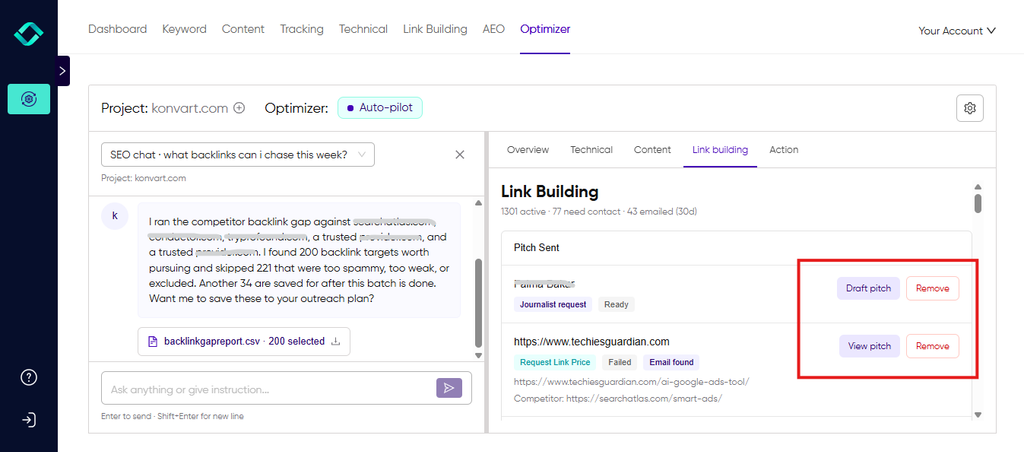
Digital PR adds a live feed of journalist requests in your industry.
7. LLM Visibility → AI visibility tracking: Citations, the sources AI answers cite, fan-out queries, an extractability audit and AI referral traffic, with prompt tracking that starts with ChatGPT.
8. White-label dashboards → white-label reports: Branded PDF reports covering traffic, rankings, AI citations, technical health and conversions, sent weekly or monthly, at no credit cost.
Where it beats Search Atlas
- Control from day one: Instead of switching on approval mode, you set permissions when you start. New pages could go live automatically, for example, while changes to your homepage and key service pages wait for your sign-off.
- Decisions based on the page, not just the issue list: The Optimizer chooses between content and link building for each page, and adapts its work to the page type.
- Outreach that runs through your own inbox: Pitches go out from your connected mailbox, so replies and relationships stay with you.
- Simpler team pricing: Plans are priced per user, with credits pooled across the team and clear costs for each action.
- Faster setup: Enter a domain and Konvart fills in the setup from your site: brand style, sitemap, competitors, services, target market and site type. You review it rather than starting from scratch.
What switching looks like in practice
A small agency with three people and five client sites, for example, would pay $135 a month for Konvart’s Team plan. That covers pooled credits, $30 of Optimizer allocation, five AI visibility sites, and white-label reports for every client. On Search Atlas, the nearest fit is Pro at $399 a month, with five seats and four OTTO sites.
Two things to plan for, though. Heavy Optimizer use across many sites may need credit top-ups. And Konvart covers SEO and AI search only.
If you rely on Search Atlas for Google Business Profile management or paid ads, you’ll need a specialist for those, such as BrightLocal for local profiles.
Konvart’s rank tracking also updates weekly on Google, so teams that sell daily, multi-engine tracking may want a dedicated tracker alongside it.
For a deeper feature-by-feature look, see our full Konvart vs Search Atlas comparison.
Pricing
- Free: $0, with 10 credits to try the tools
- Individual: $30/month, 1 user, 250 credits. Optimizer usage runs on top-ups.
- Team: $45/user/month, minimum 2 users. Credits are pooled, each user adds $10 of Optimizer allocation, and the plan includes 5 AI visibility sites plus MCP and API access.
- Extra credits: $10 for 50
- Annual billing: 11% off
Compared with Search Atlas Starter at $99 a month for one seat, Konvart’s Individual plan covers a solo marketer for less than a third of the price. See the pricing page for credit costs by feature.
Switch to Konvart if you want Search Atlas’s automation with more control over what goes live, and most of its other tools in one place, at a lower and more predictable price.
2. Alli AI
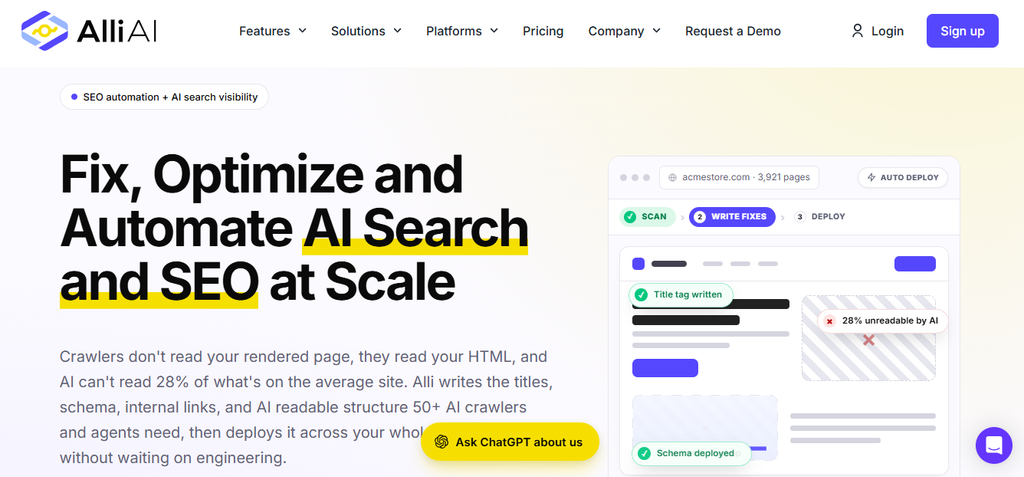
Alli AI is an SEO automation platform focused on technical and on-page changes at scale.
Like OTTO, it lets you push optimizations across many pages from one dashboard, without waiting on developers.
It installs through a WordPress plugin, a JavaScript snippet or your existing tag manager, and works with platforms including WordPress, Shopify, Webflow, HubSpot and Salesforce.
Quick facts: Replaces OTTO’s technical and on-page automation · From $299/month($249/month billed annually) · 10-day free trial
Where it beats Search Atlas
- Built for large and complex sites: Bulk on-page edits, schema and technical fixes across thousands of pages are its core focus.
- Pre-rendering for crawlers: It can serve pre-rendered pages to search engines and AI crawlers, which helps sites built heavily on JavaScript get read properly.
- SEO testing: You can A/B test SEO changes to see what actually moves rankings before rolling them out site-wide.
- Review before deploying: You can review recommendations and apply only the changes you approve.
Worth knowing
Alli AI replaces OTTO’s technical side, not the rest of Search Atlas. Its plans include keyword tracking, a site speed optimizer and standard reports, but deep research, content writing and outreach will need other tools.
Because changes are applied through a script on your site, test page speed before and after you roll out large batches of changes, and keep running a regular site audit so you can confirm what search engines actually see.
Pricing
- Business: $299/month, or $249/month billed annually
- Agency: $599/month
- Enterprise: custom
- Trial: 10 days
At $299 a month,Alli AI costs more than Search Atlas Growth ($199) for automation alone, so it makes most sense for teams whose biggest need is technical changes at scale.
Switch to Alli AI if OTTO’s technical automation was the main reason you used Search Atlas, and you manage large or JavaScript-heavy sites where bulk changes and pre-rendering matter most.
3. Semrush
Semrush is one of the most widely used SEO platforms, and it’s best known for the depth of its keyword, competitor and traffic data.
For teams leaving Search Atlas because they want stronger research rather than more automation, it’s often the first tool they look at.
Semrush (now part of Adobe) sells its features as separate toolkits, so you can choose SEO, content and AI visibility separately or bundle them.
Quick facts: Replaces research, audits, rank tracking, content (with the Content Toolkit) and AI visibility (with the AI Visibility toolkit) · From $139/month($117.33/month billed annually) · 7-day free trial
Where it beats Search Atlas
- Research depth: Its keyword and competitor databases are among the largest available, and they include paid search data, which helps teams that run SEO and PPC side by side.
- Daily rank tracking: Position Tracking updates daily, with 500 keywords on Pro, 1,500 on Guru and 5,000 on Business.
- Competitive gap tools: Keyword Gap and Backlink Gap sit side by side, so you can see which competitors outrank you and which sites link to them. Our guide to backlink gap analysis shows how to turn that kind of list into real link prospects.
- A mature reporting tool: My Reports combines Semrush data with Google Analytics and Search Console in scheduled PDF or online reports, with white-label options per report.
Worth knowing
Semrush is a research and monitoring platform first. It tells you what to fix and where the opportunities are, but your team, or another tool, makes most of the changes.
Teams coming from OTTO often notice this most: the audits are thorough, yet the fixes don’t happen on their own.
The pricing model is also very different. Instead of one plan that includes everything, you build your setup from toolkits:
- SEO Classic Pro: $139/month, 5 websites, keyword research, competitor analysis, Position Tracking, Backlinks and Site Audit
- SEO Classic Guru: $249/month($208.33/month billed annually), 15 websites, historical data and content optimization tools
- SEO Classic Business: custom pricing, 40+ websites, API access, Share of Voice and team users
- Content Toolkit: $60/month on its own
- AI visibility: sold as a separate toolkit, or bundled with SEO in Semrush One plans
- White-label reports: Pro reports at $20/month each through My Reports
For a team that needs SEO, content and AI visibility together, the total can match or exceed Search Atlas Growth ($199) quickly.
The difference is that you pay only for the toolkits you use.
Agencies weighing it against other platforms can see how it compares on cost at 10 clients in our roundup of the best SEO tools for agencies.
Switch to Semrush if you want the deepest keyword and competitive data available, and you have the team, or another tool, to act on what it finds.
4. SE Ranking
SE Ranking is an all-round SEO platform that covers most of Search Atlas’s research and reporting jobs at a mid-market price.
Rank tracking, site audits, keyword and backlink research, a content editor, local marketing tools and AI visibility tracking are all included in its main plans.
Its Agency Pack then adds a white-labeled platform for clients.
Quick facts: Replaces research, audits, rank tracking, content, local tracking, AI visibility and white-label reporting (with the Agency Pack) · From $129/month($103.20/month billed annually) · 14-day free trial, no card needed
Where it beats Search Atlas
- Unlimited research: Keyword, competitor and backlink research are unlimited on both plans, so you don’t watch a credit balance every time you look something up.
- Daily tracking for more keywords: Core tracks 2,000 keywords daily and Growth 5,000.
- AI visibility on every plan: Both plans track 25 AI prompts a day across 5 AI engines, with an AI Search add-on for wider coverage.
- White-label for less: The Agency Pack adds a white-labeled platform, client seats and unlimited scheduled reports for $69/month (annual billing), without moving to a top-tier plan.
What it costs an agency in practice
A three-person agency managing 10 to 30 client sites would likely choose Growth, which includes 30 projects and 3 manager seats.
Add the Agency Pack for white-labeling, and the total comes to about $292/month on annual billing.
On Search Atlas, white-label dashboards start on Pro at $399/month, with four OTTO sites.
The trade-off is automation. SE Ranking audits your sites and recommends fixes, but your team makes the changes.
Pricing
- Core: $129/month($103.20/month billed annually): 10 projects, 1 manager seat, 2,000 daily keywords, 250,000 audit pages, 25 content articles
- Growth: $279/month($223.20/month billed annually): 30 projects, 3 manager seats, 5,000 daily keywords, 2 million audit pages, 50 content articles, full project history
- Agency Pack: +$69/month, annual billing only. Adds white-labeling, 30 client seats and unlimited scheduled reports.
- AI Search add-on: from $71/month
- Enterprise: custom
Switch to SE Ranking if you used Search Atlas mainly for research, rank tracking and client reporting, and you’d rather have predictable limits and a lower price than built-in automation.
5. Ahrefs
Ahrefs is best known for its backlink data, which many SEOs consider the most comprehensive available.
Over the years, it has grown into a full research suite, with keyword research, site audits, rank tracking, web analytics and AI visibility tracking.
For teams that used Search Atlas mainly for research and link building, it’s the strongest data upgrade on this list.
Quick facts: Replaces backlink and keyword research, site audits, rank tracking and AI visibility checks · From $129/month (Lite) · Annual billing saves up to 17%
Where it beats Search Atlas
- Backlink data: Site Explorer shows who links to any site, which links were gained or lost, and which pages attract the most links. It’s the foundation for link audits and prospecting.
- Wide competitor comparisons: Link Intersect compares up to 10 competitors at once, so you can find sites that link to several of them but not to you.
- Content research: From the Standard plan, Content Explorer shows which content earns links and traffic in your niche, which helps you plan pieces worth pitching.
- AI visibility built into every plan: Each paid plan includes AI prompt checks across major AI platforms, with Brand Radar AI available for deeper research.
A tip if you’re coming from Search Atlas
Ahrefs finds link opportunities brilliantly, but it doesn’t reach out to anyone.
Search Atlas bundled link building and press release services, so teams switching to Ahrefs often notice a gap between “here’s the list” and “we won the link.”
Plan for that step before you switch.
Either budget time for manual outreach, or pair Ahrefs’ prospect lists with an outreach tool that finds contacts, sends pitches and tracks the links you win.
The same goes for fixes: Ahrefs’ always-on audits flag issues, but implementing them is up to your team.
Pricing
- Lite: $129/month: 750 tracked keywords, 150 AI prompt checks, 1,000 credits per user, 6 months of history, 1 user (up to 2 more at $40/month each)
- Standard: $249/month: 2,000 tracked keywords, 300 AI prompt checks, unlimited credits, 2 years of history, Content Explorer and Portfolios (up to 5 more users at $60/month each)
- Advanced: $449/month: 5,000 tracked keywords, 600 AI prompt checks, 5 years of history and a Data Studio integration (up to 10 more users at $80/month each)
- Enterprise: $1,499/month
- Brand Radar AI: from $199/month
Most link-focused teams end up on Standard, since Lite’s credit cap and missing reports, such as Content Explorer and broken backlinks, limit serious link work.
With two extra users, Standard comes to $369 a month, close to Search Atlas Pro, but with no automation or outreach included.
Switch to Ahrefs if link building and competitive research were your main reasons for using Search Atlas, and you want the deepest backlink data available.
6. Surfer
Surfer is a content optimization platform, and for teams that mainly used Search Atlas’s Content Genius, it’s the most direct replacement.
Its editor scores drafts against the pages already ranking, and its higher plans track how your brand appears across the major AI models, next to the content work.
Quick facts: Replaces Content Genius and LLM Visibility · From $49/month billed yearly (Discovery) · Free to start
Where it beats Search Atlas
- A focused, mature editor: Real-time Content Score, term and structure guidance, AI SEO guidelines, and 1-click content optimization from the Standard plan.
- Content planning across your site: From Pro, Content Ideas and Coverage Gap show topics you’re missing site-wide, and a cannibalization report flags pages competing for the same searches.
- Daily AI tracking for content teams: Pro tracks 50 prompts daily across ChatGPT, Perplexity, Gemini, AI Overviews and AI Mode, with Mention Gap and Brand Sentiments to show where competitors get mentioned and you don’t.
- Works where writers work: WordPress and Google Docs integrations from Standard, plus brand spaces for keeping clients or brands separate.
Choosing the right plan
Surfer’s plans differ a lot in what they include, so match the plan to the Search Atlas jobs you’re replacing:
- Discovery ($49): content creation and optimization only, with no AI tracking.
- Standard ($99): adds tracking, but only 25 ChatGPT prompts, refreshed weekly.
- Pro ($182): brings daily tracking across five AI models, plus Coverage Gap, internal linking and brand spaces. This is the plan most teams leaving Search Atlas would need to cover both content and AI visibility.
Surfer won’t replace OTTO’s technical fixes, research or rank tracking, so it usually sits alongside another platform.
For a wider look at content tools, including options that also publish changes to your site, see our comparison of the best content optimization tools.
Pricing (billed yearly)
- Discovery: $49/month: 120 documents, no AI tracking
- AI Search Analytics: $82/month: AI tracking only, 50 prompts across 5 models
- Standard: $99/month: 360 documents, 25 ChatGPT prompts weekly
- Pro: $182/month: 360 documents, 50 prompts daily across 5 models, 5 brand spaces
- Peace of Mind: $299/month: unlimited documents, 100 prompts, API access
- Enterprise: custom, including white-label
Monthly billing costs more: about $59, $95, $119, $219 and $359 respectively.
Switch to Surfer if content creation and optimization were the parts of Search Atlas you used most, and you want strong AI visibility tracking alongside them.
7. BrightLocal
BrightLocal is built for local SEO, and it’s the strongest replacement on this list for Search Atlas’s Google Business Profile and local tools.
It covers what local clients care about most: where they rank on the map, whether their listings are accurate, and how their reviews look.
Pricing scales by location, which suits multi-location businesses and agencies with local clients.
Quick facts: Replaces GBP Galactic, local heatmaps and local audits · From $41/monthperlocation($31/month billed annually) · 14-day free trial, no card needed
Where it beats Search Atlas
- Deeper local tracking: Every plan tracks up to 100 keywords and four competitors per location, with a geo-grid map showing how a business ranks across its area for up to five keywords.
- Local audits: Local SEO audits, Google Business Profile audits benchmarked against competitors, and citation accuracy monitoring that spots gaps in a business’s listings.
- Listings and reviews in one place: The Manage plan keeps business details synced across key sites and schedules profile posts. Grow adds review monitoring, responses and requests by email, SMS or in store, and lets you publish reviews on your website.
- Local AI visibility: Every plan includes a Local AI Visibility Tracker covering ChatGPT and Google’s AI.
How it fits into a new setup
BrightLocal doesn’t try to be an all-in-one platform. Content, backlink research, technical audits beyond local and on-page automation all need another tool.
Most teams that leave Search Atlas for BrightLocal pair it with a main SEO platform.
BrightLocal handles listings, reviews and profiles, while the main platform handles everything else, often including local rank tracking alongside the rest of each client’s SEO data.
The pricing model works differently too.
Search Atlas includes a set number of Google Business Profiles in each plan: 3 on Starter, 10 on Growth, 25 on Pro and 100 on Agency. BrightLocal charges per location, and the price per location drops as you add more.
For a business with a handful of locations, that can be much cheaper. For an agency managing dozens, compare the totals carefully.
Pricing (per location)
- Track: $41/month($31/month billed annually)
- Manage: $54/month($40/month billed annually): adds listing sync, AI Insights and profile post scheduling
- Grow: $65/month($49/month billed annually): adds review management
- Citation Builder: pay-as-you-go on every plan
Annual billing saves 25%.
Switch to BrightLocal if Google Business Profiles, local rankings and reviews were the main reasons you used Search Atlas, especially for local or multi-location clients.
8. Peec AI
Peec AI is a dedicated AI visibility platform. If tracking how your brand appears in ChatGPT, Perplexity, Gemini, and Google’s AI results was the part of Search Atlas you valued most, Peec AI goes deeper on that one job than any all-in-one platform.
Quick facts: Replaces LLM Visibility · From $95/month($80/month billed annually) · Unlimited users on every plan
Where it beats Search Atlas
- Built only for AI visibility: Daily tracking, competitor comparisons and source insights that show which websites AI engines rely on for their answers.
- You choose the engines: Every plan tracks three AI engines of your choice, from a list that includes ChatGPT, Perplexity, Google AI Overviews, AI Mode, Gemini and Bing AI Mode.
- Unlimited competitors and users: You can benchmark against as many competitors as you need, and give access to your whole team or your clients without per-seat fees.
- Agency plans: Dedicated agency plans are designed for managing several client brands, with unlimited client seats, MCP and API access, and a Looker Studio integration.
Tracking is only half the job
Peec AI shows where you stand in AI answers and which sources shape them.
Improving that position is a separate piece of work: updating pages so AI tools can quote them, and earning mentions on the sites they cite.
Search Atlas bundled some of that work into the same platform, so plan for it when you switch.
Some teams pair a dedicated tracker with tools for content and outreach. Others choose a platform where AI visibility tracking sits next to the SEO work that improves it.
Getting quoted by journalists is one of the most direct ways onto cited sources, which is where a feed of journalist requests helps.
Pricing
- Starter: $95/month($80/month billed annually): 50 prompts, 3 AI models, daily tracking, 1 project, 1 country
- Pro: $245/month($205/month billed annually): 150 prompts, 2 projects, 3 countries
- Advanced: $495/month($420/month billed annually): 350 prompts, 5 projects, multiple countries and Looker Studio
- Enterprise: custom, with unlimited prompts, projects and models
- Agency plans: from $205/month billed annually
Search Atlas Pro tracks six AI platforms alongside the rest of its SEO tools for $399 a month. Peec AI tracks three engines per plan, but in more depth, and starts at $95.
Switch to Peec AI if AI visibility is becoming a core service for you or your clients, and you want deeper tracking than an all-in-one platform provides.
9. AgencyAnalytics
AgencyAnalytics is a client reporting and dashboard platform built for agencies.
It isn’t an SEO tool in the same sense as the others on this list: it doesn’t research keywords or fix pages.
What it does is replace the client-facing side of Search Atlas, its white-label dashboards and client portals, with a dedicated reporting platform that covers far more channels than SEO.
Quick facts: Replaces white-label dashboards and client portals · From $25perclient/month($20 billed annually) · 14-day free trial
Where it beats Search Atlas
- Every channel in one report: More than 90 integrations pull in SEO, Google Ads, social media, call tracking and more, so clients see all their marketing in one branded dashboard.
- A fully white-labeled portal: Clients log in on your custom domain, under your brand, whenever they like.
- Reports that go out on time: Scheduled reports, approval before sending, annotations that explain changes, and AI summaries to speed up the commentary.
- Unlimited staff accounts: Your whole team can work in it without per-seat costs.
Where it fits after Search Atlas
On Search Atlas, white-label dashboards start on the Pro plan ($399 a month), and full client portals on Agency (from $999).
AgencyAnalytics charges per client instead, so an agency with 10 clients would pay around $250 a month on monthly billing for portals and reports, before any add-ons.
The catch is that it reports on data rather than collecting SEO data itself. You’ll still need an SEO platform underneath it for research, audits and rankings.
If your clients are happy with branded PDF reports rather than a login, a platform with built-in white-label SEO reports may cover it without a second subscription.
Our comparison of SEO reporting tools goes deeper on the trade-offs.
Pricing
- Core: $25 per client/month, or $20 per client/month billed annually
- Rank Tracker add-on: from $41.67/month per 500 keywords (billed annually)
- AI Tracker add-on: from $20.83/month per 250 credits (billed annually)
Switch to AgencyAnalytics if client reporting across several marketing channels was a big part of why you used Search Atlas, and you want a branded portal clients can log in to anytime.
That’s all nine alternatives. Whichever you choose, the move itself needs a little planning, especially if OTTO has been making changes to your site for months.
How to Switch From Search Atlas Without Losing Rankings
Switching SEO platforms isn’t risky in itself. Most ranking drops after a switch come from a few avoidable mistakes: losing track of changes that were made automatically, running two tools that edit the same pages, or cancelling before the new setup is ready.
Work through these steps in order.
1. List the jobs you actually use
Go back to the job-by-job table and tick the rows you rely on every week.
That list decides your new setup: one main platform for most of the ticks, and a specialist only where you need extra depth.
2. Record what OTTO has changed
OTTO may have changed titles, meta descriptions, schema, internal links, alt text and redirects across hundreds of pages. Before you change anything, export or note down what’s been deployed on your most important pages.
Search Atlas says its optimizations stay live after cancellation, and it offers an option to preserve them.
Even so, confirm with Search Atlas exactly how your changes will be kept, and whether you need to leave its pixel, plugin or connector in place, before you remove anything from your site.
3. Export your data
Download everything you might want later:
- Rank tracking history and keyword lists
- Content drafts, briefs and topic plans
- Audit history and outstanding issues
- Backlink and outreach lists, including contacts and link statuses
- Client reports, if you’re an agency
- Google Business Profile data, such as posts, reviews and response templates
4. Set your baselines
Before switching, note where things stand. That includes clicks, impressions and average position for your top pages in Search Console, key events such as calls, forms and orders in GA4, and how you appear in AI answers for your main queries.
If something moves after the switch, you’ll know whether it was already moving before.
5. Set up the new tools before you cancel
Run your new setup alongside Search Atlas for a few weeks if you can. Connect Search Console and Analytics, add your competitors and keywords, and run a fresh site audit so you have a clean starting point.
In Konvart, for example, setup is prefilled from your domain, including your services, competitors and target market, so most of this takes minutes rather than days.
6. Set permissions before any automation goes live
If your new tool makes changes for you, decide what it’s allowed to do before you switch it on.
A sensible starting point is to let routine fixes, such as missing alt text or meta descriptions, run automatically, while changes to your homepage and key service or product pages wait for approval.
7. Never run two automation tools on the same pages
This is the most common mistake. If OTTO and a new tool both edit titles, schema or internal links on the same pages, they can overwrite each other or leave duplicate tags behind.
Hand each site over to one tool at a time.
8. Move one site first
If you manage several sites, switch one first and watch it for four to six weeks before moving the rest.
Small movements are normal while search engines recrawl pages. Our guide on how long SEO takes to work explains what’s realistic for changes to show up.
Switching is mostly a matter of planning. Your existing optimizations stay in place, your data comes with you, and the new tool takes over one site at a time.
Most teams find the hardest part is the first week, when they decide which jobs to keep, which to drop and how much control to give automation. Once that’s settled, the new setup usually runs with less checking and less spending than before.
That leaves one last decision: which alternative, or which combination, fits your team best.
How to Choose The Right Search Atlas Alternative
By now, you’ve seen that no single tool replaces every part of Search Atlas, and most teams don’t need one that does.
The right choice depends on four things: the jobs you actually use, how much automation you want, how many people and sites you manage, and whether you rely on the parts of Search Atlas that sit outside SEO.
1. Which jobs do you use every week?
Go back to your ticks in the job-by-job table. If most of them sit in one tool’s column, that’s probably your main platform.
If one job stands out as critical, such as local SEO for a multi-location business or AI visibility for a brand that sells it as a service, that’s where a specialist earns their place.
2. How much do you want done for you?
This is the biggest dividing line on the list:
- You want changes made for you, with control: look at tools like Konvart that apply fixes and publish changes within permissions or approvals you set.
- You want changes made at scale on complex sites: look at tools built for bulk technical deployment.
- You’re happy to make changes yourself: a research suite with deep data may be all you need.
If you’re unsure, our roundup of automated SEO software compares the tools that does more than reporting.
3. How many people and sites do you manage?
Pricing models matter more as you grow. Search Atlas ties its plans to OTTO sites, seats and credits.
Alternatives price by user, by client, by location or by toolkit.
Work out what each option costs for your real setup, such as three people and eight sites, not for the entry plan.
4. Do you rely on Google Business Profile management or paid ads?
These are the two Search Atlas jobs that SEO alternatives rarely cover.
If you manage many Business Profiles, plan on a local specialist. If you run ads from Search Atlas’s Ad Studio, you’ll need a dedicated ad platform.
If you use neither, you have far more options.
Whichever setup you choose, start small. Pick the tool that covers the jobs you use most, run it on one site alongside your current setup, and compare the results, the time your team spends and the monthly bill after a few weeks.
Most free trials on this list are long enough to tell you whether a tool fits before you commit, and that’s a far better guide than any feature list, including this one.
Keep The Jobs, Lose What You Don’t Need
Search Atlas set out to put every part of SEO in one place, and for some teams it still does exactly that.
But if you’re reading this, something has probably stopped fitting: the bill as you’ve grown, automation that acts before anyone reviews it, or a dashboard full of tools you never open.
The good news is that you don’t have to find a perfect copy, you only need to replace the jobs you actually use:
- For automation, choose a tool that makes changes for you, with the level of control you’re comfortable with.
- For research, choose the depth of data your work really needs.
- For specialist jobs like local SEO, AI visibility or client reporting, add a dedicated tool only where it clearly does better.
- For the switch itself, record what’s changed, set your baselines and move one site at a time.
If you’d like to keep most of what Search Atlas did in one platform, with a clearer say in what goes live, Konvart covers automation, research, audits, content, outreach, AI visibility and white-label reports.
It sets itself up from your domain, and its Optimizer works within the permissions you choose, so routine fixes can run on their own while important pages wait for your approval.
Get your SEO work done, with approvals you control (7-day free trial)
Frequently Asked Questions
What are the main Search Atlas competitors?
Search Atlas competes with several kinds of tools. All-in-one SEO suites like Konvart, Semrush, SE Ranking and Ahrefs cover research, audits and rank tracking. SEO automation platforms like Konvart’s Optimizer compete with OTTO by applying changes for you. Specialists compete with individual modules: Surfer for content, BrightLocal for local SEO and Business Profiles, Peec AI for AI visibility and AgencyAnalytics for client reporting.
What’s the closest alternative to OTTO SEO?
The closest alternatives are SEO automation platforms like Konvart that apply fixes and publish changes for you, not research tools that only report issues. When comparing them, look at what they can change (technical fixes, on-page updates, content), which website platforms they support, and how much control you get. Some act on their own by default, while others work within approvals or permissions you set.
Is there a cheaper alternative to Search Atlas?
Yes, depending on what you use. Search Atlas starts at $99 a month, or $79 billed annually, with limits on sites, seats and credits. Several alternatives cover most of the same jobs for less, especially those priced per user. If you only use one or two features, a specialist tool or Google’s free tools may cost less than any all-in-one plan.
Will I lose OTTO’s changes if I cancel Search Atlas?
Search Atlas says its optimizations stay live after you cancel, and it offers an option to preserve them. Before cancelling, confirm with Search Atlas how your changes will be kept, and whether you need to leave its pixel, plugin or connector in place. It’s also wise to record the main changes on your key pages and note your current rankings, so you can spot any differences after you switch.
Can one tool replace everything Search Atlas does?
Rarely. Search Atlas combines SEO automation, research, content, local SEO, Google Business Profile management, link building, AI visibility, reporting and paid ads. Some all-in-one platforms cover most of the SEO and AI visibility jobs, but Business Profile management and paid ads usually need separate tools. Most teams replace Search Atlas with one main platform plus one or two specialists.
Does Search Atlas have a free trial?
Yes. Search Atlas offers a 7-day trial with a free one-to-one onboarding session. Its pricing page lists four paid plans: Starter at $99 a month, Growth at $199, Pro at $399 and Agency from $999, with lower prices on annual billing. If you’re comparing alternatives, many offer free trials or free plans, so you can test them on one site before switching.