A backlink gap analysis compares your backlink profile with your competitors’ to find websites that link to them but not to you.
Those sites are some of your best link prospects, because they’ve already shown they link to content like yours.
That’s what makes it so much more effective than cold prospecting.
Instead of pitching hundreds of sites that have never heard of you or your topic, you’re focusing on sites that are relevant to your niche, actively linking out, and already linking to businesses like yours.
The question isn’t whether they’ll link to a site in your space. It’s whether they’ll link to yours.
In this guide, you’ll learn what a backlink gap analysis is, how to run one step by step, how to tell which gaps are worth closing, and how to turn the results into real links.
There’s also a worked example and a look at a newer kind of gap: the sources AI tools cite for your topic.
Key takeaways
- A backlink gap is the set of sites that link to your competitors but not to you. These sites are pre-qualified prospects because they already link to content in your niche.
- The best prospects link to two or more of your competitors. A site that links to several businesses like yours is the most likely to link to you too.
- Filter for quality before you reach out: Relevance, authority, and real traffic matter more than the size of your prospect list.
- How a competitor earned a link tells you how to earn it too. A review site, a resource page, and a guest post each need a different pitch.
- Konvart’s backlink gap tool compares you with multiple competitors at once and sends the best prospects straight into outreach.
What is Backlink Gap Analysis?
Backlink gap analysis is the process of comparing the websites that link to you with the websites that link to your competitors.
The “gap” is every site that links to one or more of your competitors but not to you.
Each one represents a link you could reasonably win, because it already links to businesses in your space.
It’s sometimes called a link gap analysis or a link intersect, and it’s one of the most reliable ways to build a list of link prospects.
Rather than guessing which sites might link to you, you start from proof: these sites already link to content like yours.
It’s different from a general backlink audit because an audit looks inward. Checking your own backlinks shows who links to you, which links are strong, and which might be harming you.
A gap analysis looks outward, at the links your competitors have that you’re missing.
Most link building strategies need both. The audit tells you where you stand, and the gap analysis tells you where to go next.
Why backlink gap analysis works
Most link building outreach fails for a simple reason: the sites being pitched have no particular reason to care.
Backlink gap analysis turns that around. Every prospect it finds has already shown three things:
- They link out: Many sites rarely link to other websites. These ones do.
- They cover your niche: They’ve linked to your competitors, so your topic is relevant to them.
- They link to businesses like yours: If they’ve linked to one of your competitors, there’s a clear case for linking to you too, especially if you can offer something better or more current.
That’s why gap prospects tend to reply more often and convert into links more often than prospects found any other way.
You’re simply asking them to do something they already do, with your content instead of, or alongside, a competitor’s.
Now that you know what a backlink gap analysis is and why it works, here’s how to run one.
How to Do a Backlink Gap Analysis (Step by Step)
A good backlink gap analysis follows the same process every time, whether you’re comparing yourself with two competitors or ten.
What changes is how much of the work you do by hand and how much a dedicated tool does for you.
The process has three stages.
First, you find the gap by choosing the right competitors and comparing backlink profiles.
Then you qualify it by filtering out weak prospects and working out how each link was earned.
Finally, you act on it by planning content, reaching out, and tracking what you win.
Many guides stop after the first stage, which leaves you with a long list of domains and no clear idea of what to do with them. But the later steps are where a gap analysis turns into actual links.
Set aside a few hours for your first run. Most of the time goes into Steps 4 and 5, where you review prospects and plan your approach.
Once your process is in place, later analyses are much quicker, because you’re only reviewing what has changed since the last one.
Step 1: Choose the right competitors
The quality of your gap analysis depends on the competitors you compare against. And your search competitors aren’t always your business competitors.
A local accounting firm might think of the firm down the road as its main rival. But for “how to file self-assessment taxes,” the pages outranking it might belong to a national software company, a personal finance blog, and a government guide.
Those are the sites whose backlinks matter for that search. Pick two to five competitors that consistently rank for the keywords you care about most.
For important pages, go a level deeper and look at page-level competitors: the specific pages outranking yours, not just the sites behind them. .
Step 2: Pull everyone’s backlink profiles
Next, gather the backlink data for your site and each competitor: the referring domains, the pages they link to, and details like anchor text and link type.
If you haven’t done this before, here’s how to find the backlinks of any website.
Focus on referring domains rather than individual backlinks.
One site might link to a competitor 200 times from its footer, but it’s still one domain and one relationship to win.
Step 3: Find the gap
Now compare the lists. You’re looking for domains that link to at least one competitor but don’t link to you.
Then sort those domains by how many of your competitors they link to. This is the most useful step in the whole process:
- Links to three or more competitors: your strongest prospects. These sites clearly link to businesses in your space, so you’re the obvious one missing.
- Links to two competitors: strong prospects worth prioritizing.
- Links to one competitor: still worth reviewing, but often more specific to that competitor’s relationships.
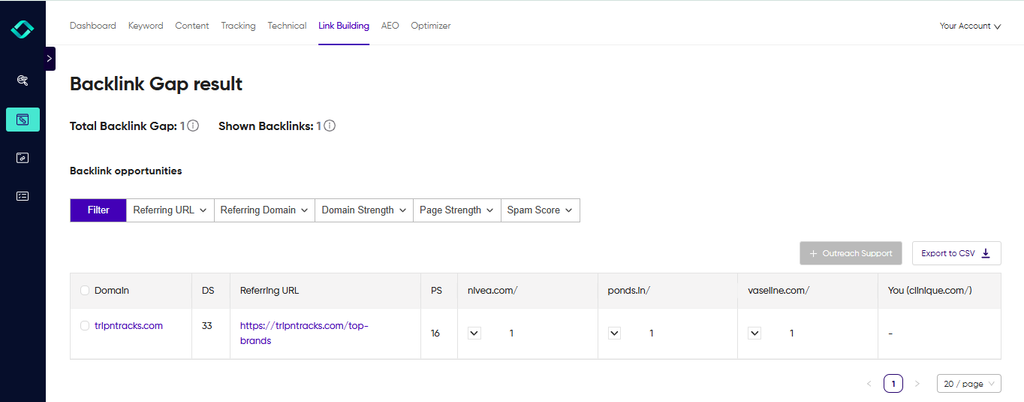
Doing this by hand means exporting several lists and cross-referencing them in a spreadsheet. Konvart’s backlink gap tool does it automatically.
You enter your site and your competitors, and it shows which domains link to them and not to you, along with Domain Strength, Page Strength, and link details for each one.
Step 4: Filter for quality
Not every gap is worth closing. Before you plan any outreach, filter the list so your time goes into the prospects most likely to help.
For each domain, check:
- Relevance: Is the site about your industry, or a closely related one? A link from a relevant site usually does more than one from a high-authority site on an unrelated topic.
- Authority: How strong is the domain and the specific linking page? Metrics like Domain Strength and Page Strength give a quick signal.
- Spam signals: Does it look like a link farm, a private blog network, or a site that sells links? A high spam score is a red flag.
- Link attributes: Are its links followed or nofollowed, and are they marked as sponsored? Nofollow links can still bring traffic and visibility, but weigh them accordingly.
- Real traffic: Does the site have an actual audience, or does it exist only to host links?
Be strict here. Links that look manipulative can do more harm than good, and Google’s link spam policy treats buying links or taking part in link schemes as spam.
Our guide to what backlinks are explains which links help and which to avoid.
Step 5: Work out how each link was earned
This is the step that turns a list of domains into a plan. Open the page that links to each competitor and look at the context.
How a competitor earned the link usually tells you how you can earn it too.
| Link type | How to spot it | How to earn it |
| Review or comparison site | The competitor is listed or reviewed alongside others | Request a review or ask to be added, with a clear reason you belong |
| Resource page | A curated list of useful tools, guides, or links | Suggest your most relevant resource as an addition |
| Guest post | An article written by someone from the competitor, with a byline | Pitch a guest article on a topic the site’s audience cares about |
| Roundup or listicle | A “best of” list that includes the competitor | Ask to be considered for the next update, with specific reasons |
| Directory | A business or industry listing | Submit your business, if the directory is genuinely relevant |
| Broken link | The competitor’s link points to a page that no longer works | Offer your content as a working replacement |
| News or PR mention | Coverage of the competitor’s news, data, or expert comment | Pitch your own story, data, or expert commentary to the same writer |
| Unlinked brand mention | The site mentions you without linking | Ask the author to turn the mention into a link |
Patterns will appear quickly. If most of a competitor’s best links come from roundups and review sites, that’s a clear signal of where your effort should go.
Step 6: Study your competitors’ most-linked pages
Look at which of your competitors’ pages have earned the most links. These are their link-worthy pages: the guides, tools, studies, and templates that other sites want to reference.
They tell you what kind of content attracts links in your niche.
If a competitor’s salary calculator has links from 150 domains, and you’re an HR software company, that’s a strong sign a better, more current calculator could earn links too.
Plan content that improves on these pages, then reach out to the sites linking to the originals once yours is live.
Step 7: Prioritize and reach out
With a filtered, categorized list, decide where to start. Score each prospect on three things:
- How many competitors it links to: more is better.
- Quality and relevance: stronger and more relevant sites come first.
- How easy the link is to earn: an unlinked mention or a broken link is quicker to win than a guest post.
Then find the right person to contact.
That’s usually an editor, a content manager, or the author of the linking page, not a generic inbox.
Match your pitch to the link type from Step 5, and keep it short, specific, and focused on why your page helps their readers.
Konvart’s outreach tools take care of the slowest parts. They find contact details, draft personalized pitches for each prospect, and send them from your connected mailbox.
Step 8: Track results and repeat
A backlink gap changes constantly. Competitors win new links, lose old ones, and publish new link-worthy pages.
Track which of your outreach efforts turned into links, and rerun your gap analysis regularly:
- Monthly if you’re in a competitive niche or running active outreach
- Quarterly for most other businesses
Monitoring your competitors between analyses also helps.
When a competitor suddenly gains links from a new source, it’s often a sign of an opportunity you can go after too.
A Backlink Gap Analysis Example
To see how the steps fit together, here’s a worked example for a fictional business. The numbers are illustrative, but the process is exactly what you’d follow.
The business: FreshCrate, a meal-kit delivery company that wants to rank for searches like “healthy meal kits” and “meal prep for beginners.”
Finding the gap
FreshCrate’s team searched its target keywords and found that the same three sites kept outranking it: two rival meal-kit brands and a popular healthy-eating blog.
These became the three competitors for the analysis, even though only two were direct business rivals.
Comparing backlink profiles in a backlink gap tool, the team found 1,240 referring domains that linked to at least one competitor but not to FreshCrate.
Sorted by how many competitors each domain linked to, the list looked like this:
| Links to | Domains | Priority |
| All three competitors | 85 | Highest |
| Two competitors | 225 | High |
| One competitor | 930 | Review later |
Instead of tackling all 1,240, the team started with the 310 domains linking to two or more competitors.
Qualifying the prospects
Next, the team filtered those 310 domains for quality. They removed:
- Sites with high spam scores or obvious link-selling pages
- Sites unrelated to food, health, or home cooking
- Sites with little or no real traffic
That left 95 strong, relevant prospects. Reviewing how each competitor had earned its links, the team grouped them by type:
| Link type | Prospects | Planned approach |
| Roundups and “best meal kits” lists | 28 | Ask to be included in the next update, with a clear point of difference |
| Recipe and nutrition blogs (guest posts) | 22 | Pitch guest recipes from FreshCrate’s in-house chef |
| Resource pages for meal planning | 17 | Suggest FreshCrate’s free weekly meal planner |
| Review sites | 14 | Offer a free box for an honest review |
| News and lifestyle coverage | 9 | Pitch survey data on how families plan weekly meals |
| Broken links | 5 | Offer replacement content for dead pages |
Learning from link-worthy pages
The healthy-eating blog’s two most-linked pages were a seasonal produce guide and a meal prep calculator, with links from more than 200 domains between them.
FreshCrate didn’t have anything similar, so it planned two new pieces: an interactive seasonal recipe guide and a calorie-aware meal prep calculator.
Once they were live, the team would pitch them to the sites linking to the originals.
Turning it into a plan
With 95 prioritized prospects and two new link-worthy pages planned, FreshCrate’s outreach plan for the next quarter was:
- Month 1: Start with the quick wins: the 5 broken links and the roundup updates. Then begin review outreach.
- Month 2: Pitch the guest recipes, and send the survey data to journalists.
- Month 3: Launch the new guide and calculator, and pitch them to resource pages and the sites linking to the competitor’s originals.
The plan ends with rerunning the gap analysis at the end of the quarter to measure what was won and find new gaps.
That gives a focused, realistic plan built entirely from sites that already link to FreshCrate’s niche.
Compare that with a cold list of 1,240 domains, most of which would never have replied.
The same idea now applies beyond traditional search. The sites AI tools cite for your topic are another kind of gap.
Find the Gaps in AI Search Too
Backlink gaps aren’t only about Google rankings anymore. When someone asks ChatGPT, Perplexity, or Gemini for a recommendation, the answer is often built from a handful of sources: review sites, industry publications, comparison articles, and forums.
If your competitors are featured on those sources and you aren’t, that’s a gap too, and it affects whether AI tools mention your brand at all.
The approach is the same as a traditional gap analysis, just with a different starting point.
Instead of comparing backlink profiles, you look at the sources AI tools cite when they answer questions about your category:
- List the questions your customers ask AI tools, such as “What’s the best travel insurance for families?” or “Which project management tool is easiest for small teams?”
- Note which sources the answers cite, and which competitors those sources mention.
- Find the sources that feature competitors but not you. These are your AI search gaps.
- Work out how to get featured, using the same link types from Step 5: a place in a roundup, a review, a guest article, or a helpful contribution to a community thread.
There’s a useful overlap here. The sources AI tools rely on are often the same high-authority, relevant sites that make strong link prospects anyway, so closing an AI search gap can strengthen your backlink profile at the same time.
Doing this by hand means running dozens of prompts and logging every source. Konvart’s AI visibility tool tracks the sources and follow-up queries behind each AI answer automatically.
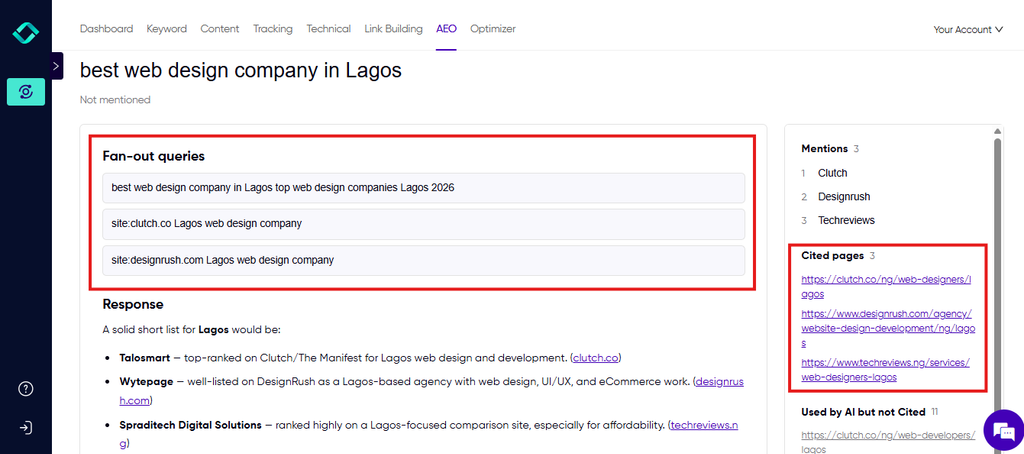
The Optimizer then turns those sources into link prospects, Reddit suggestions, or content fixes you can approve.
For a deeper look at tracking your brand in AI answers, see our guide to LLM visibility.
Common Backlink Gap Analysis Mistakes
A backlink gap analysis is simple in principle, but a few common mistakes can turn a strong list of prospects into wasted outreach.
Most of them come from rushing the early steps or treating every prospect the same way.
So, here are a few mistakes to avoid:
1. Comparing yourself with the wrong competitors: It’s natural to start with the businesses you compete with for customers. But if they don’t rank for your target keywords, their backlinks won’t tell you much about what it takes to rank.
Base your analysis on the sites that actually outrank you in search, and add page-level competitors for your most important pages.
2. Chasing authority over relevance: A link from a high-authority site in an unrelated industry looks impressive in a spreadsheet, but it often does less for your rankings than a link from a smaller, highly relevant site.
It’s also much harder to win. Relevance should come first, and authority second.
3. Treating the whole gap as a to-do list: A gap of 1,000+ domains can feel like 1,000 opportunities. In reality, many will be low quality, irrelevant, or tied to a competitor’s personal relationships.
Start with the domains that link to several competitors, filter hard, and focus on a shortlist you can pursue properly.
4. Sending the same pitch to every prospect: A review site, a resource page, and a journalist all need different approaches.
A generic “please link to us” email ignores how each link was earned, and that’s why so much outreach goes unanswered.
Match every pitch to the link type.
5. Ignoring page-level gaps: Domain-level analysis shows you the big picture, but your most valuable pages need their own attention.
Comparing the backlinks of the pages outranking yours for a specific keyword often reveals more targeted, more winnable opportunities.
6. Running it once: Your competitors’ backlink profiles change every month. A gap analysis from six months ago misses the links they’ve won since, and the new sources linking in your niche.
Make it a regular part of your link building, not a one-off project.
Avoiding these mistakes comes down to a careful, repeatable process. The challenge is that doing it by hand takes time, because you’re exporting data, cross-referencing lists, filtering prospects, and finding contacts for each one.
That’s where the right tool makes the biggest difference.
Backlink Gap Analysis: The Manual Way vs The Konvart Way
Every step in this guide works whichever way you do it. But if you’re doing it by hand, a single backlink gap analysis can take a full day or more, and much of that time goes into exporting, sorting, and copying data rather than actually winning links.
Here’s how the same process looks done manually and in Konvart.
| Stage | The manual way | The Konvart way |
| Pulling backlink data | Export backlink lists for your site and each competitor, one at a time | Enter your site and your competitors, and the backlink gap tool pulls everything in one place |
| Finding the gap | Combine the exports in a spreadsheet and cross-reference them with formulas to find domains that link to competitors but not to you | See the gap in seconds, including which domains link to several competitors |
| Filtering for quality | Check each domain’s authority, spam signals, and link type across different tools | Review Domain Strength, Page Strength, spam scores, anchor text, and follow or nofollow links side by side |
| Finding link-worthy pages | Dig through each competitor’s backlinks to work out which pages earn the most links | See each competitor’s most-linked pages straight away |
| Finding contacts | Search each site for an editor or author, then look up their email address | Push prospects straight into Outreach Support, which finds contact details for you |
| Writing pitches | Write each email from scratch, or adapt a generic template | Get AI-drafted pitches tailored to each site and link type, ready to review and edit |
| Sending and following up | Copy each pitch into your email, then track replies and follow-ups by hand | Send pitches and follow-ups from your connected mailbox, without leaving Konvart |
| Tracking changes | Repeat the whole process every month or quarter to see what’s changed | Track competitors’ new and lost links over time, so new gaps show up as they appear |
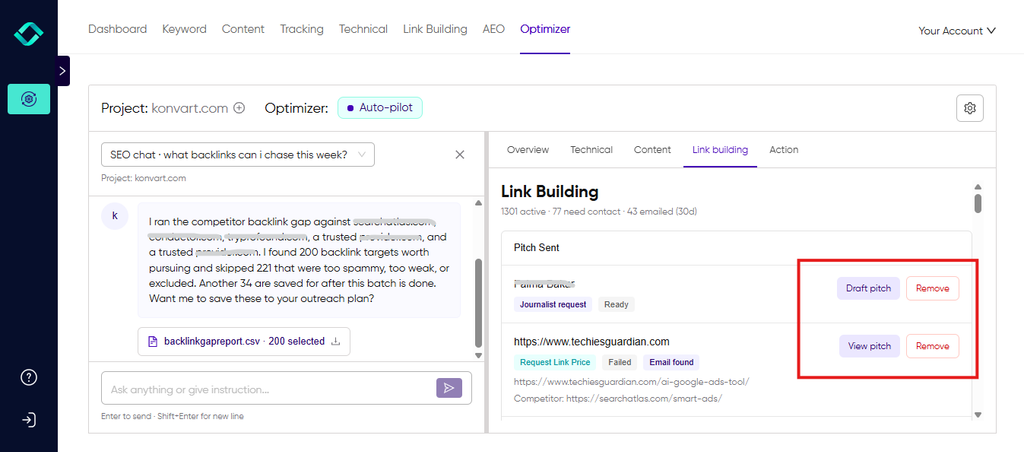
The difference isn’t only speed. When finding the gap, qualifying prospects, and reaching out all happen in one place, nothing gets lost between steps.
A strong prospect doesn’t sit forgotten in a spreadsheet, and you spend your time on the conversations that actually win links.
Find your backlink gaps today. Start a 7-day free trial, no card required.
Final Thoughts: Turn Your Competitors’ Links Into Your Next Wins
Your competitors’ backlinks are one of the most useful maps you have in SEO. They show which sites link in your niche, what kind of content earns links, and where your own profile is falling behind.
A backlink gap analysis turns that map into a focused list of prospects who already link to businesses like yours.
And the process itself is straightforward. Choose the competitors that actually outrank you, find the sites linking to them but not to you, and filter hard for quality.
Work out how each link was earned, learn from your competitors’ most-linked pages, and match every pitch to the link type.
Then repeat it regularly, because the gap keeps changing.
If you want to find your backlink gaps and turn them into outreach in one place, Konvart is built for that.
It compares your site with your competitors, shows which prospects are worth pursuing, finds the right contacts, and drafts tailored pitches you can send from your own mailbox.
Need a trial? Create a free Konvart account and explore the platform
Frequently asked questions
What is backlink gap analysis?
Backlink gap analysis is the process of comparing your backlink profile with your competitors’ to find websites that link to them but not to you. These sites are strong link prospects because they already link to content in your niche. The analysis helps you build a focused list of sites to reach out to, instead of pitching sites at random.
How do I find my backlink gap?
Choose two to five competitors that outrank you for your target keywords. Then compare their referring domains with yours, and list the domains that link to them but not to you. Sort the list by how many competitors each domain links to, and start with those linking to two or more. A backlink gap tool like Konvart’s does this comparison for you in seconds.
How many competitors should I compare?
Most businesses get the best results from comparing two to five competitors. Fewer than two makes it hard to spot patterns, and comparing too many can bury the strongest prospects in a very long list. Choose the competitors that consistently outrank you in search, not just your biggest business rivals.
How often should I do a backlink gap analysis?
Run a backlink gap analysis monthly if you’re in a competitive niche or doing active outreach, and quarterly for most other businesses. Competitors win and lose links all the time, so regular analysis keeps your prospect list current.
Is backlink gap analysis white hat?
Yes. Backlink gap analysis is simply a research method for finding relevant sites to approach. It’s white hat as long as you earn the links through genuine outreach, useful content, or real relationships. Buying links or joining link schemes goes against Google’s spam policies, no matter how you found the prospects.
What’s the difference between a backlink gap and a keyword gap?
A keyword gap shows the keywords your competitors rank for that you don’t, which helps you decide what content to create. A backlink gap shows the sites that link to your competitors but not to you, which helps you decide where to earn links. Used together, they show both what to publish and how to build the authority those pages need to rank.
Can I do a backlink gap analysis for free?
You can do a basic version by hand, but it’s slow and limited. Free backlink data usually covers only part of a site’s profile, and cross-referencing several competitors in a spreadsheet takes hours. A dedicated tool gives you fuller data and does the comparison automatically. You can try Konvart’s backlink gap tool with a 7-day free trial, no card required.
How long does it take to see results from a backlink gap analysis?
The analysis itself can take minutes with a dedicated tool, while outreach usually takes weeks to turn into links. Once new links are live, it often takes several more weeks for search engines to find them and for rankings to respond. Most teams see the clearest results after a few months of consistent outreach.