LLM visibility, also called AI visibility, is how often AI tools like ChatGPT, Gemini, Perplexity, and Claude mention or cite your brand when people ask about your category.
It’s the AI-era version of showing up on page one. If someone asks an AI tool for the best option in your space and your brand isn’t in the answer, you’ve lost them before they ever reach a website.
That shift is already happening. People now ask AI tools for recommendations, comparisons, and how-to advice they would once have typed into a search bar, and many act on the answer without clicking a single link.
Ranking well on Google still matters, but it no longer guarantees that AI tools will name you.
In this guide, you’ll learn:
- what LLM visibility is
- which metrics to track
- how to measure it step by step
- and the actions that make AI tools more likely to mention and cite your brand
Key Takeaways
- LLM visibility measures whether AI tools mention or cite you, not where you rank. A brand can rank on page one and still be missing from AI answers.
- AI answers already shape buying decisions. In an April 2026 survey of US AI users, 45% said they had first discovered a brand through an AI-generated answer.
- You can start tracking for free. A list of 20 to 50 prompts, a spreadsheet, and a simple GA4 setup will show where you stand and how much traffic AI tools send you.
- AI answers often cite third-party sites, such as review platforms, industry publications, and forums. Getting featured on the sources AI already trusts matters as much as improving your own pages.
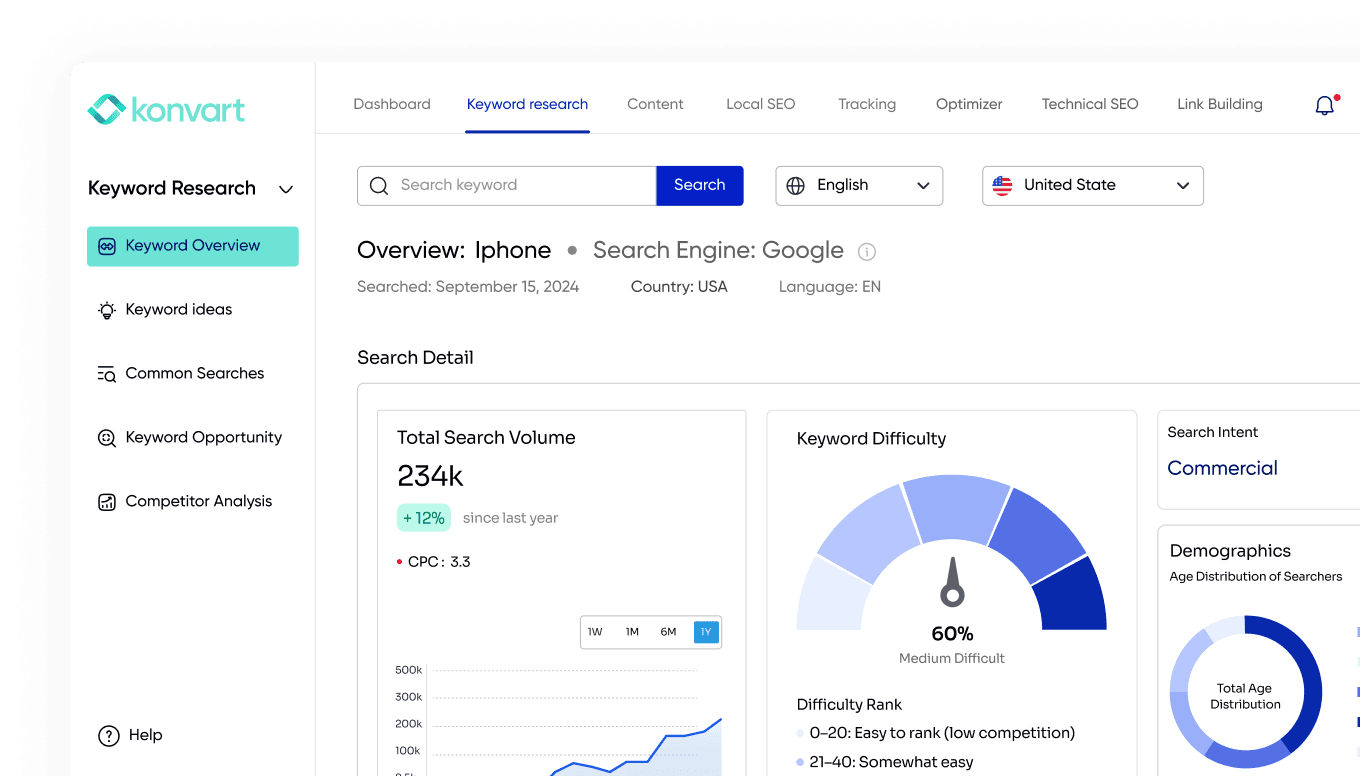
- Tracking is only half the job. Tools like Konvart’s AI visibility tool show which sources and follow-up queries shape each answer, so you know exactly what to fix next.
What is LLM Visibility?
LLM visibility is a measure of how present your brand is in the answers AI tools give.
“LLM” stands for large language model, the technology behind ChatGPT, Gemini, Claude, and Perplexity.
When someone asks one of these tools a question about your industry, LLM visibility describes whether your brand appears in the answer, how it’s described, and whether your website is linked as a source.
It’s closely tied to answer engine optimization (AEO), the practice of shaping your content and online presence so AI tools are more likely to include you.
LLM visibility is how you measure whether that work is paying off.
Mentions vs citations
Your brand can appear in an AI answer in two ways, and they’re worth tracking separately.
A mention is when the AI names your brand in its answer.
For example, if someone asks “What’s the best accounting software for freelancers?” and the answer lists your product, that’s a mention. It builds awareness, even if there’s no link.
A citation is when the AI links to one of your pages as a source for its answer.
Citations are rarer and often more valuable, because they show the AI relied on your content, and they can send visitors straight to your site.
The two don’t always go together, though. An AI tool might mention your brand while citing a review site as its source, or cite your blog post without naming your brand at all.
Tracking both shows the full picture. A tool like Konvart tracks mentions and citations side by side, so you can see where you’re named, where you’re linked, and where a competitor is getting the credit instead.
LLM visibility vs SEO rankings
LLM visibility and SEO rankings measure different things, and doing well at one doesn’t guarantee the other.
| SEO rankings | LLM visibility | |
| What it measures | Where your page ranks in search results | Whether AI tools mention or cite your brand in their answers |
| Where it happens | Google, Bing, and other search engines | ChatGPT, Gemini, Perplexity, Claude, Google AI Overviews and AI Mode |
| What the user sees | A list of links to choose from | A single written answer, sometimes with sources |
| How stable it is | Fairly stable from day to day | Can change each time the same question is asked |
| What drives it | Relevance, content quality, links, technical health | Clear, quotable content, plus how often trusted sources mention you |
| How you track it | Rank tracking tools and Search Console | Prompt tracking across AI tools, plus AI referral traffic |
The two still overlap. Many AI answers draw on pages that already rank well in search, so strong SEO gives you a head start.
But AI tools also pull from forums, review sites, and publications you don’t control, which is why a brand can rank on page one and still be missing from AI answers.
Now that you know what LLM visibility is, the next question is why it’s worth the effort.
Why LLM Visibility Matters
For years, getting found online meant ranking in search results. Someone typed a question, scanned a list of links, and chose where to click.
AI tools have changed that journey. Now, many people ask a question and get a single written answer that names a few brands, compares them, and suggests what to choose, often before they’ve visited a single website.
That puts a lot of weight on the answer itself. A 2026 survey of 1,000 US adults who use AI search found that:
- 45% had first discovered a brand or service through an AI-generated answer, rising to 59% among Gen Z
- 58% said a brand cited as a source in an AI answer seems more trustworthy than one that isn’t mentioned
- 63% were more likely to engage with brands they saw referenced across multiple AI answers
- 60% agreed that AI answers directly influence their decisions
Those numbers point to three reasons LLM visibility deserves a place in your marketing plan.
1. AI answers are becoming the first impression
When an AI tool answers a question, it often gives the complete answer on the page.
People may never scroll through a list of links or visit the sites behind the answer. So, if your brand is named, you’re part of the decision from the start.
If it isn’t, many buyers won’t know you were an option.
2. Being mentioned builds trust
People tend to treat AI answers as a shortcut to expert advice.
A brand that’s named, and especially one that’s cited as a source, gets borrowed credibility from that answer.
A brand that keeps appearing across different questions and different AI tools starts to look like the obvious choice in its category.
3. Your competitors may already be there
AI answers usually name a handful of brands. If a competitor is consistently recommended for the questions your customers ask, it’s winning attention you never got the chance to compete for.
And because AI tools often draw on the same trusted sources each time, that advantage can build on itself unless you act.
There’s a practical upside too. Visitors who arrive from AI tools have often already read a recommendation, so they come in with context.
Tracking the traffic AI tools send you shows how much that audience is worth to your business, and whether your visibility is turning into visits.
Here’s the full section again with a longer intro and more depth in each metric. The sources metric was already the longest, so I’ve only tightened it.
The LLM Visibility Metrics That Matter
LLM visibility isn’t a single number. A brand can be mentioned often but described inaccurately, or cited regularly for one topic and invisible for another.
A competitor can also appear in fewer answers than you but get recommended first every time. So, if you only track whether you show up, you miss most of what’s happening.
That’s why it helps to look at LLM visibility from a few angles. Some metrics measure awareness, some measure trust, and some show you what to do next.
Together, the six below give you a full picture of where you stand, how you compare with competitors, and which actions are most likely to improve your results.
1. Mentions
Mentions count how often AI tools name your brand in their answers. Track them across a set list of prompts and AI tools, then work out your mention rate: the share of prompts where your brand appears.
If you’re named in 12 of 50 prompts, your mention rate is 24%.
It’s also worth noting where in the answer you’re mentioned. Being listed first in a recommendation carries more weight than appearing fifth, or in a closing line like “other options include…”.
And split your mention rate by prompt type.
Many brands find they’re mentioned when people ask about them by name, but rarely when people ask general questions about the category.
Those general questions are where new customers come from.
Mention rate is the clearest single measure of awareness in AI search, and the easiest metric to track by hand when you’re starting out.
2. Citations
Citations count how often AI tools link to your pages as a source.
Your citation rate works the same way as mention rate: the share of prompts where at least one of your URLs is cited.
Look at which pages are cited, not just how often. If AI tools keep citing one guide on your site, it’s doing something right.
It probably answers the question directly, uses clear structure, or includes specific facts. Compare it with pages that never get cited, and you’ll usually find the gaps quickly.
Citations also vary by AI tool. Perplexity tends to show sources prominently with every answer, while other tools cite less often or only for certain questions.
Tracking citations per tool helps you understand where your content is being picked up and where it isn’t.
3. Share of voice
Share of voice compares your visibility with your competitors’. For each prompt, record which brands are named, then compare totals.
If competitors appear in 70% of answers and you appear in 20%, that gap tells you more than either number alone.
Share of voice also shows which competitors AI tools favor, and for which questions.
One competitor might dominate “best tool for small businesses” prompts, while another owns comparison questions.
That tells you which battles to fight first, and which competitor’s sources and content are worth studying.
This is often the metric leadership cares about most, because it shows where you sit in your market, not just in isolation.
4. Accuracy and sentiment
Being mentioned is only good news if the AI gets you right. Check whether answers describe your product, pricing, and features correctly, and whether the tone is positive, neutral, or negative.
Common problems include:
- Outdated information, such as old pricing, discontinued plans, or features you’ve since added that AI tools don’t know about
- Mistaken identity, where you’re confused with a similarly named company or product
- Missing context, where you’re described too narrowly, such as “a tool for agencies” when you serve businesses of all sizes
- Negative framing borrowed from an old review, a complaint thread, or a competitor’s comparison page
Each of these is usually a sign that the sources AI relies on need updating, whether that’s your own pages, your listings on review sites, or how you’re described elsewhere online.
Accuracy matters most for prompts close to a buying decision, such as pricing and comparison questions, where a wrong detail can cost you a customer.
5. Sources
Sources are the websites an AI tool relies on to build its answer. They might be review sites, industry publications, forums like Reddit, competitor blogs, or your own pages.
This is the most useful metric for improving your visibility, because it shows exactly where the AI is getting its information.
If the same three review sites keep shaping answers in your category, those are the places to be featured.
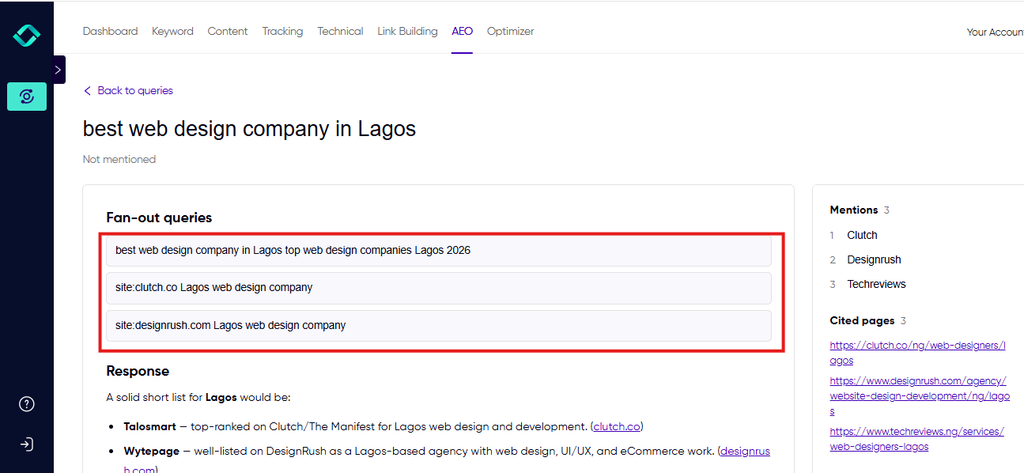
Many AI tools also break a question into several related searches behind the scenes, known as fan-out queries.
So, knowing what those are shows which follow-up questions your content needs to answer. Konvart’s AEO tool shows the sources and fan-out queries behind each answer, so you can see what’s shaping the result, not just the result itself.
6. AI referral traffic
AI referral traffic is the number of visits your site gets from AI tools like ChatGPT, Perplexity, Gemini, and Claude.
It connects visibility to results: are mentions and citations turning into real visitors?
Don’t judge it on volume alone. AI referral traffic is often small next to search traffic, but these visitors arrive with context.
They’ve usually just read a recommendation or an answer that cited your page, so they tend to know what they’re looking for.
Compare how they behave against visitors from search: which pages they land on, how long they stay, and whether they sign up or buy.
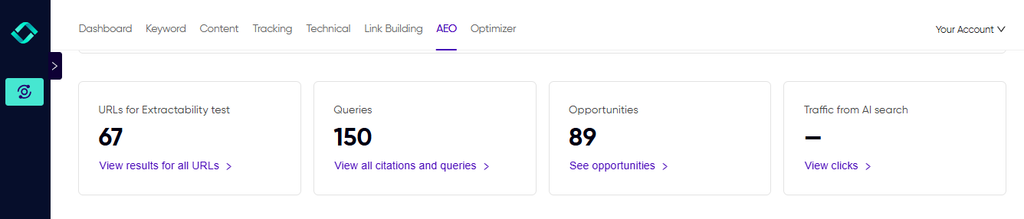
Konvart’s AEO dashboard brings these signals together in one view, so you’re not piecing them together from spreadsheets and analytics reports:
- Extractability tests check how easily AI tools can pull clear answers from your pages, and flag the ones that need restructuring.
- Tracked queries show your citations for each prompt you monitor, along with the sources and competitors that appear alongside you.
- Opportunities turn what the data shows into a list of next steps, such as pages to improve, sources to target, and questions to answer.
- Traffic from AI search shows the clicks AI tools send to your site, so you can see whether visibility is turning into visits.
With the metrics clear, the next step is measuring them, starting with a method you can set up today for free.
How to Track LLM Visibility (Step by Step)
The method below works for any business. It takes a few hours to set up and an hour or two to repeat each time.
It also shows you exactly what a dedicated tool needs to do, so you’ll know what to look for when you’re ready to automate it.
Step 1: Build your prompt list
Start by writing down the questions your customers actually ask AI tools. These are your prompts, and they’re the foundation of everything you track.
Aim for 20 to 50 to begin with, spread across four types:
- Category prompts: broad questions about your market, such as “What’s the best payroll software for small businesses?” These matter most, because they’re where people discover brands they don’t know yet.
- Problem prompts: questions about the problem you solve, without naming a product type, such as “How do I pay remote contractors in different countries?”
- Comparison prompts: questions that put you against competitors, such as “Gusto vs Rippling vs [your brand]” or “alternatives to [competitor].”
- Branded prompts: questions about your brand directly, such as “Is [your brand] good for startups?” or “How much does [your brand] cost?” These show whether AI tools describe you accurately.
To find the right questions, look at your sales calls, support tickets, and Search Console queries.
Note the “People also ask” questions for your main keywords too. The questions customers ask you are usually the same ones they ask AI.
Step 2: Choose which AI tools to check
You don’t need to track every AI tool from day one. Start with the ones your audience is most likely to use:
- ChatGPT, the most widely used AI assistant
- Google AI Overviews and AI Mode, which appear directly in Google search
- Perplexity, which shows its sources with almost every answer
- Gemini and Claude, which are increasingly used for research and work tasks
If your audience is mostly B2B, ChatGPT, Perplexity, and Claude are a good start.
For consumer brands, ChatGPT and Google’s AI features usually matter most.
Step 3: Run your prompts and record the results
Run each prompt in each AI tool and log what you see. Use a clean browser session or a logged-out account where possible, since personal chat history can affect the answers.
Here’s a simple way to set up your spreadsheet:
| Column | What to record |
| Prompt | The exact question you asked |
| Prompt type | Category, problem, comparison, or branded |
| AI tool | ChatGPT, Perplexity, Gemini, and so on |
| Date | When you ran it |
| Mentioned? | Yes or no |
| Position | First, second, later, or only in passing |
| Cited? | Yes or no, plus the URL if yes |
| Competitors named | Every other brand in the answer |
| Sources cited | The websites the answer links to |
| Accuracy notes | Anything wrong or outdated about your brand |
Once a round is done, calculate your mention rate, citation rate, and share of voice for each AI tool.
The “Sources cited” column is worth a careful look. A handful of websites usually show up again and again, and those are the sources shaping answers in your category.
Step 4: Repeat on a schedule, and expect variation
Ask an AI tool the same question twice, and you may get two different answers.
Brands appear in one run and disappear in the next, and the order changes. That’s normal, and it’s why a single check tells you very little.
Track trends instead of single results:
- Weekly for your most important prompts, such as top category and comparison questions
- Monthly for the rest of your list
- Run each priority prompt more than once per check, and record how many times out of three or five your brand appears
Over a few weeks, you’ll see whether your mention rate is steady, rising, or falling, and whether changes you make to your content are having an effect.
Step 5: Know when to move to a tool
Manual tracking is a great way to start, but it gets heavy fast. Twenty prompts across five AI tools, run three times each, is 300 answers to read and log every week.
It’s also easy to miss patterns, such as a source that keeps appearing or a competitor that’s slowly gaining ground.
That’s usually the point to automate.
An AI visibility tool like Konvart runs your prompts on a schedule, records mentions, citations, and sources automatically, and tracks the traffic AI tools send you, so your time goes into acting on the data instead of collecting it.
Tracking shows you where you stand. The next step is changing it.
How to Improve Your LLM Visibility
Once you know where you stand, you can start changing it. There’s no switch that makes AI tools recommend your brand, and you can’t control what they say directly.
But you can shape the information they draw on: your own content, the sites that talk about you, and how consistently your brand is described across the web.
The seven actions below cover the areas that make the biggest difference.
Start with the ones your tracking points to. If AI tools describe you inaccurately, begin with consistency.
If competitors keep getting cited from the same review sites, begin with sources.
1. Make your pages easy for AI to quote
AI tools favor content they can lift cleanly into an answer. A page that buries its main point under a long introduction is harder to use than one that answers the question in its first sentence or two.
A few habits make a big difference:
- Answer the question directly, near the top of the page or section, before you explain it.
- Use descriptive headings that match the questions people ask, such as “How much does payroll software cost?” rather than “Pricing considerations.”
- Break information into lists and tables where it fits, especially steps, comparisons, and specifications.
- Include specific facts: numbers, dates, prices, and named examples are more quotable than general statements.
Konvart’s extractability audit checks how easily AI tools can pull answers from your pages, and the Content Editor helps you restructure the ones that fall short.
Structure only goes so far, though. AI tools still favor content with real substance, which is why AI-written pages still need a human edit before they’re likely to be cited.
2. Get featured on the sources AI already cites
AI answers often lean on third-party websites: review platforms, industry publications, comparison articles, and “best of” lists.
If the same few sites keep shaping answers in your category, being featured there can do more for your visibility than another page on your own site.
Go back to the “Sources cited” column in your tracking spreadsheet and list the sites that appear most often. Then work out how to earn a place on each one.
That might mean getting listed on a review platform, pitching a guest article, offering expert input to a journalist, or asking to be added to an existing roundup.
Digital PR and targeted outreach are the most direct ways to get there.
This is also where tracking sources pays off.
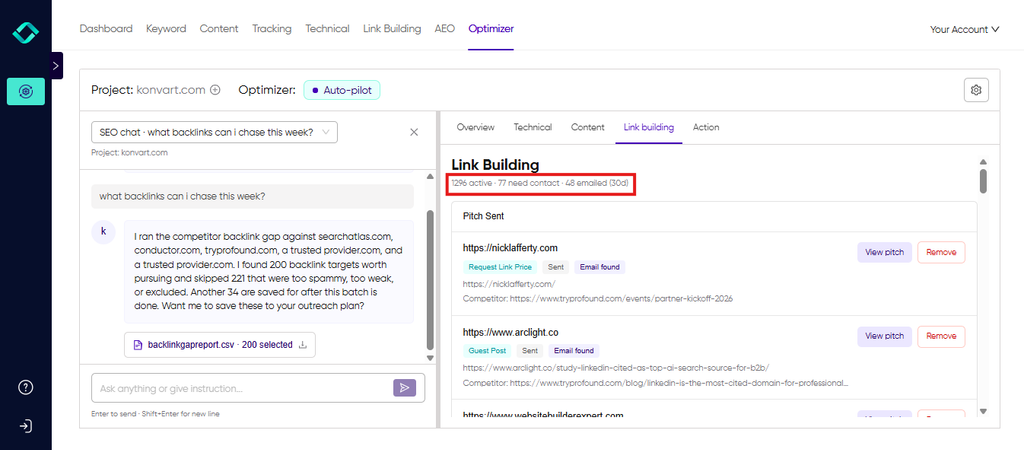
Konvart’s Optimizer takes the sources behind AI answers and turns them into link prospects you can reach out to, so you’re not building the list by hand.
3. Join the conversations AI learns from
Forums and communities, especially Reddit, show up often in AI answers.
People ask real questions there, and the replies read like genuine recommendations, which is exactly the kind of content AI tools look for.
The key is to be useful, not promotional. Answer questions in your area of expertise, share what’s worked for you, and mention your product only where it genuinely helps.
A pet food brand, for example, will get further by answering questions about switching a dog’s diet than by posting links to its products.
Over time, consistent, helpful participation makes your brand part of the conversation AI tools draw from.
4. Keep your brand facts consistent everywhere
AI tools build their picture of your brand from everything they can find. If your website says one price, an old review says another, and a directory listing describes a product you no longer sell, the answer can end up wrong or vague.
Audit the places your brand appears most:
- Your own website, especially pricing, product, and about pages
- Review platforms and app marketplaces
- Business directories and social profiles
- Partner and integration pages
Make sure your name, description, pricing, and key features match across all of them.
When you change something important, update these listings at the same time. This is the most direct fix for the accuracy problems you find in your tracking.
5. Answer the follow-up questions too
When someone asks an AI tool a question, the tool often runs several related searches in the background to build its answer.
These are the fan-out queries mentioned earlier.
A question like “What’s the best CRM for real estate agents?” might also trigger searches for pricing, integrations, mobile apps, and ease of use.
If your content only answers the main question, you may miss the others.
Look at the fan-out queries for your key prompts, and make sure your pages cover those related questions clearly, either on the same page or on supporting pages linked from it.
6. Keep key pages fresh
AI tools tend to favor current information, especially for topics where details change, such as pricing, features, statistics, and “best of” lists.
A page last updated two years ago is less likely to be trusted than one that’s clearly current.
Review your most important pages regularly. Update statistics, refresh examples, add new features, and show a visible “last updated” date.
Focus first on the pages AI tools already cite, since keeping them accurate protects the visibility you’ve earned.
7. Don’t neglect your SEO
LLM visibility and SEO work together. Many AI answers draw on pages that already rank well in search, and Google’s AI Overviews and AI Mode are built into search itself.
So, strong rankings give your content a better chance of being found, read, and cited by AI tools.
Keep doing the fundamentals: target the right keywords, fix technical issues, build quality links, and track how your rankings change alongside your AI visibility.
The brands that perform best in AI answers are usually the ones that are already strong in search.
Improving LLM visibility takes consistent effort, and a few common mistakes can slow it down. Here’s what to avoid.
Common LLM Visibility Mistakes
Most mistakes with LLM visibility come from treating it like traditional SEO, or from drawing conclusions too quickly.
These are the ones that hold brands back most often.
1. Checking once and drawing conclusions: AI answers change from one run to the next, so a single check is a snapshot, not a result.
A brand that’s missing today may appear tomorrow, and the reverse is just as true.
Track the same prompts on a schedule and judge your visibility by the trend.
2. Tracking only branded prompts: It’s encouraging to see an AI tool describe your brand well when you ask about it by name.
But people who already know your name aren’t the ones you need to win.
Category and problem prompts show whether you’re being discovered by new customers, and they’re usually where the biggest gaps are.
3. Counting mentions but ignoring accuracy: A mention that gets your pricing wrong, or describes a product you’ve retired, can do more harm than no mention at all.
Read the answers, not just the tallies, especially for questions close to a buying decision.
4. Focusing only on your own website: Improving your own pages matters, but AI answers often rely on review sites, publications, and forums.
If you ignore the sources AI tools actually cite, you’re working on only part of the picture.
5. Treating AI visibility and SEO as separate projects: The two share much of the same foundation: helpful content, a strong reputation, and a site that’s easy to understand.
Teams that split them up often duplicate work, or let one fall behind while chasing the other.
Avoiding these mistakes comes down to two habits: track consistently over time, and act on what the data shows.
Doing both by hand is possible, but it gets harder as your prompt list, your competitors, and the number of AI tools grow.
That’s where the right tool makes the work much lighter.
The Faster Way: Track and Improve LLM Visibility With Konvart
Tracking LLM visibility by hand works, but it takes time. Running dozens of prompts across several AI tools every week, logging every answer, and spotting which sources keep appearing can easily fill a day.
And even when the spreadsheet is done, it doesn’t tell you what to fix.
Konvart’s AI visibility tool handles both the tracking and the next steps:
- Track your prompts automatically: See where ChatGPT, Perplexity, Claude, and Gemini mention and cite your brand, and how often competitors appear instead.
- See what shapes each answer: View the sources and fan-out queries behind every prompt, so you know which sites and follow-up questions are driving the result.
- Check your pages for extractability: Find out how easily AI tools can pull answers from your content, and which pages need restructuring.
- Turn insights into actions: The Optimizer turns the sources behind AI answers into Reddit suggestions, link prospects, and content fixes, ready for you to review and approve.
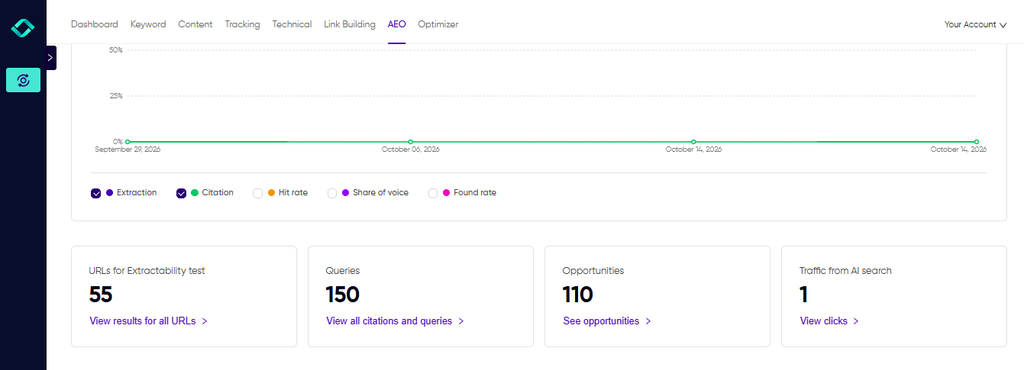
- Measure the results: Track the traffic AI tools send to your site, and see whether your visibility is turning into visits.
With all these, you get LLM visibility you can track and act on in one place, without the spreadsheets.
See where your brand stands in AI answers. Start a 7-day free trial, no card required.
Final thoughts: Make Sure AI Tools Know Your Brand
More and more buying journeys now start with a question to an AI tool. When that tool answers, it names a handful of brands and leaves the rest out.
LLM visibility tells you which side of that line you’re on, and what to do about it.
But the good news is that it’s measurable and you can improve it.
Start with a clear list of prompts, track your mentions, citations, and sources over time, and watch the traffic AI tools send you.
Then focus on what moves the result: content AI can quote, a presence on the sources it trusts, consistent brand facts, and strong SEO underneath it all.
If you want to track your LLM visibility and know exactly what to fix, Konvart’s AI visibility tool is built for that.
It shows where AI tools mention and cite you, the sources and follow-up questions behind each answer, and the traffic you get from AI search. The Optimizer then turns those insights into actions you can approve.
Create a free Konvart account and see how you can improve your brand’s visibility in AI engines.
Frequently Asked Questions
What is LLM visibility?
LLM visibility is how often AI tools like ChatGPT, Gemini, Perplexity, and Claude mention or cite your brand when people ask questions about your category. It covers whether you’re named in the answer, how accurately you’re described, and whether your website is linked as a source.
Is LLM visibility the same as AI visibility?
Yes. In marketing, LLM visibility, AI visibility, and AI search visibility all describe how your brand appears in AI-generated answers, and the terms are used interchangeably.
How do I check if ChatGPT mentions my brand?
Ask ChatGPT the questions your customers would ask, such as “What’s the best [product type] for [use case]?”, and note whether your brand appears. Use a logged-out or clean session, run each question more than once, and record the results in a spreadsheet. To track this at scale, an AI visibility tool can run your prompts automatically.
How often should I track LLM visibility?
Track your most important prompts weekly and the rest monthly. AI answers change from one run to the next, so regular tracking shows the trend instead of a one-off snapshot. Run priority prompts several times per check, and record how often your brand appears.
Why do AI answers change every time I ask?
AI tools generate each answer fresh, so the wording, the brands mentioned, and their order can vary even when the question is the same. Answers can also change as the tools update their models or pull from different sources. That’s why LLM visibility is best measured as a rate over many runs, not by a single answer.
Can I control what AI tools say about my brand?
Not directly, but you can influence it. AI tools build their answers from the information available about you. Clear, accurate content on your website, consistent brand details across directories and review sites, and a presence on the sources AI tools trust all make accurate, positive mentions more likely.
How is LLM visibility different from SEO?
SEO measures where your pages rank in search results. LLM visibility measures whether AI tools mention or cite your brand in their answers. The two overlap, because many AI answers draw on pages that rank well in search. But AI tools also rely on forums, review sites, and publications, so strong rankings alone don’t guarantee visibility in AI answers.
Does ranking on Google help LLM visibility?
Yes, it often helps. Many AI answers, including Google’s AI Overviews and AI Mode, draw on pages that already rank well, so strong SEO gives your content a better chance of being found and cited. It isn’t enough on its own, though. Being mentioned on trusted third-party sites and writing content that AI can easily quote matter too.